
When you start shopping for a new garage door, you'll quickly realize there are four main players in the game: sectional, roll-up, side-hinged, and tilt-up designs. Each one works a bit differently, and they’re all built to solve specific problems—from the space-saving sectional doors that dominate residential neighborhoods across Texas and Oklahoma to the tough-as-nails roll-up doors common in commercial spaces. Making an informed choice is key to a long-lasting, valuable investment.
Your Quick Guide to Garage Door Types
Picking the right garage door for your Texas or Oklahoma property is a bigger deal than you might think. It’s not just about looks; it directly impacts your property's security, curb appeal, and even your energy bills. With the global garage door market projected to hit $15 billion by 2025, innovation is booming, giving property owners more choices than ever. Knowing the basic differences between styles is the best way to make a smart, data-backed investment.
Think of the decision like a flowchart. Are you tight on space? Is budget your top priority? Or are you going for a classic, timeless look? The infographic below can help you sort through those priorities.
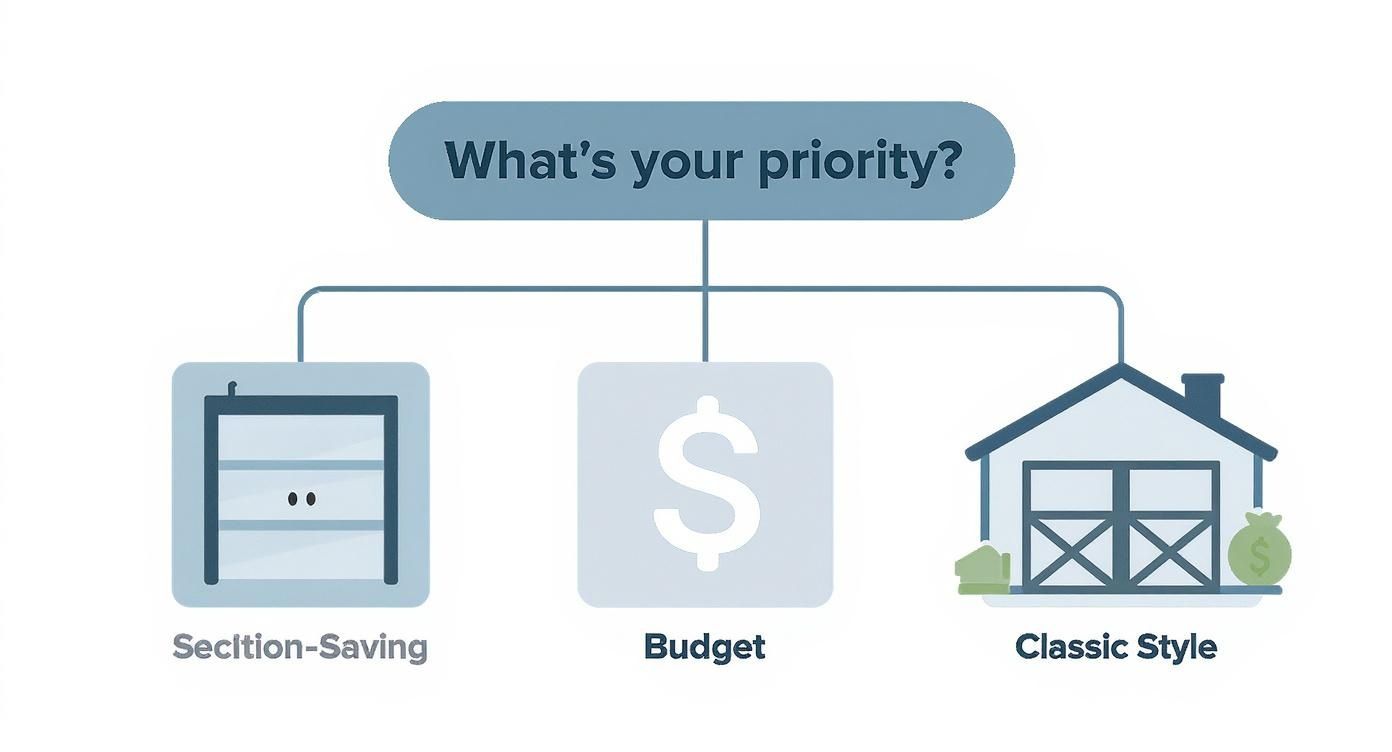
As you can see, sectional doors are the go-to for most homeowners, largely because they are masters of saving space—a huge plus for modern home and garage designs common in both residential and commercial applications.
Core Door Styles Explained
Let's dive into the main types you'll come across. Each one has its own set of strengths, and the best fit really depends on how your garage is built and what you need from it day-to-day.
-
Sectional Doors: By far the most popular choice for homes today, accounting for over 75% of residential installations in the U.S. They're made of several horizontal panels hinged together. When you open the door, it rides up on a track and tucks away neatly along the ceiling, taking up almost no extra room.
-
Roll-Up Doors: You’ll see these more in commercial buildings, but they have residential applications too. Built for heavy use, the door is made of small slats that coil up into a compact roll above the opening. This makes them perfect for garages where ceiling space is at a premium. A good guide to roller shutter door options can provide more detail on this practical style.
-
Side-Hinged Doors: Think of classic barn doors. These swing open from the middle, just like the doors inside your house. They offer a beautiful, traditional look and are ideal if you have ceiling obstructions (like storage or light fixtures) that would get in the way of a standard track.
-
Tilt-Up Canopy & Retractable Doors: Both are solid, one-piece doors that pivot outward and upward. The main difference is how they rest when open. A canopy style leaves a small portion of the door sticking out from the garage, creating a little overhang. A retractable style, on the other hand, slides all the way into the garage on horizontal tracks.
To make things even clearer, let's compare these common styles side-by-side.
Garage Door Types At a Glance
This table breaks down the essentials for each primary garage door style, giving you a quick snapshot to help guide your decision for your Texas or Oklahoma property.
| Door Type | How It Opens | Typical Cost | Best For |
|---|---|---|---|
| Sectional | Rolls up in sections along a ceiling-mounted track. | $800 – $3,500 | Most residential garages; homes where driveway space is limited. |
| Roll-Up | Coils into a tight roll directly above the door opening. | $900 – $4,000 | Garages with low ceilings; commercial or high-security needs. |
| Side-Hinged | Swings open outwards from the center like a double door. | $1,200 – $5,000+ | Garages with ceiling obstructions and ample driveway clearance. |
| Tilt-Up | A single panel that pivots out and up, either partially or fully. | $600 – $2,500 | Budget-conscious homeowners; garages with clear overhead space. |
Ultimately, the right door is the one that best balances your property's architecture, your budget, and how you use your garage every day.
A Look at the Top Residential Garage Door Styles

When you pull into your driveway, the garage door is often the first thing you see. It’s a huge part of your home's exterior, which means it has a massive impact on curb appeal and even property value. For homeowners here in Texas and Oklahoma, picking a door isn't just about looks; it has to stand up to our unique climate, too.
Let's walk through the most common residential garage door styles out there. The goal is to find that perfect blend of style and function that fits your home, your driveway, and your daily life.
The Ever-Popular Sectional Door
There's a reason sectional doors are the reigning champs in the residential world—you see them everywhere. These doors are built from a series of horizontal panels hinged together. When you open the door, these panels glide up along a track system that curves back, running parallel to your garage ceiling.
The genius of this design is its biggest selling point: it requires zero outswing space. You can park your truck right up to the garage and still open the door without a problem. This space-saving trick makes them a perfect fit for just about any home, no matter the driveway size.
On top of that, the panel construction opens up a world of design possibilities. From classic raised panels that mimic traditional wood doors to ultra-modern flush designs, you can customize them with different window layouts and materials. If you’re looking for a do-it-all option that is both practical and stylish, checking out our residential garage doors and accessories is a great place to start.
The Classic Side-Hinged Door
Want to add a touch of timeless charm? Side-hinged doors, which bring to mind classic carriage houses or rustic barns, might be the answer. They operate just like the main doors to your house, swinging open from the middle on hinges mounted to the door frame.
Actionable Tip: Side-hinged doors are a fantastic workaround for garages with limited overhead space. If you have ceiling-mounted storage racks, low-hanging light fixtures, or anything else that would block a standard track system, these doors give you full access without the headache. This is a common issue in both older homes and commercial workshops.
The one major catch, however, is the clearance they need. You have to have enough room in your driveway for the doors to swing outward fully. This makes them a tough sell for homes with short or steeply sloped driveways. While you can automate them, the mechanisms tend to be a bit more complex than what you'd find on a sectional door.
The Sleek Tilt-Up Door
Tilt-up doors, sometimes called one-piece doors, are a simple and often very cost-effective choice. The door is a single, solid slab that pivots out and up, eventually resting horizontally inside the garage. They generally come in two flavors:
- Canopy Tilt-Up: This version leaves about a third of the door sticking out from the garage when open, creating a little awning.
- Retractable Tilt-Up: This type uses horizontal tracks to pull the entire door slab completely inside the garage, leaving the opening totally clear.
While tilt-ups offer a clean, unbroken look, they share the same main drawback as side-hinged doors: they need a lot of space to operate. The door swings out quite a bit as it opens, so you can't park too close. They work great for homes with long, flat driveways where that outswing isn't a concern.
A Closer Look at Commercial and Industrial Garage Doors
When you’re running a business in Texas or Oklahoma, a garage door isn't just an entry point—it's mission-critical equipment. We're not talking about the doors you find on a typical suburban home. These are industrial workhorses, built from the ground up for extreme durability, relentless high-cycle performance, and rock-solid security. Making the right choice here directly affects your operational flow, your energy bills, and how well you can protect your assets.
Commercial doors are built with heavier-gauge steel, beefier track systems, and powerful operators engineered to handle thousands of open-and-close cycles every year without breaking a sweat. This heavy-duty construction is absolutely essential for busy warehouses, loading docks, and auto service centers from Dallas to Oklahoma City.
High-Performance Sectional Steel Doors
For businesses that need a solid mix of thermal efficiency, toughness, and custom options, insulated sectional steel doors are usually the go-to solution. They function much like residential sectional doors, but these are made with significantly thicker steel and packed with high-density polyurethane foam insulation.
The result is an impressive R-value, which is a crucial number for any climate-controlled facility. A higher R-value means less heat transfer, keeping your workspace bearable during a brutal Texas summer and holding onto warmth through an Oklahoma winter. That thermal break translates into real, measurable energy savings over the life of the door. Plus, their robust panel design offers fantastic security and can be fitted with windows or pass-through doors for extra convenience.
Coiling Steel and Roll-Up Doors
If your top priorities are maximizing overhead space and absolute security, coiling steel doors (often just called roll-up doors) are the undisputed industry standard. Instead of sliding back along the ceiling, these doors coil up tightly into a compact roll just above the opening. This design is a lifesaver for warehouses with towering ceilings or loading docks where you have cranes and tall forklifts moving around.
Industry Insight: According to OSHA standards (specifically 29 CFR 1910), proper door selection and maintenance are vital for workplace safety. Heavy-duty coiling doors are often preferred in high-traffic industrial areas because their simple, rugged design minimizes potential failure points and provides superior protection against unauthorized entry.
Built from a curtain of interlocking steel slats, these doors are incredibly tough to breach, making them a perfect choice for protecting valuable inventory. You can explore a full range of these powerful solutions by checking out our commercial door services.
Specialty Commercial Doors for Unique Needs
Beyond the common sectional and coiling doors, many businesses in Texas and Oklahoma have unique operational demands that call for a specialized solution.
- High-Speed Doors: Think cold storage facilities or fast-paced manufacturing plants. These fabric or rubber doors open and shut at speeds up to 100 inches per second to maintain strict environmental control and improve the flow of traffic. They are truly built for extreme, high-cycle use.
- Full-View Aluminum Doors: You've probably seen these at modern restaurants, car dealerships, and fire stations. Featuring large glass panels in a sturdy aluminum frame, they provide a sleek, contemporary look while flooding the interior with natural light and offering great visibility.
Each of these different type of garage doors built for commercial use is required to meet strict safety and performance codes, including UL 325, which regulates the safety of motor operators. Choosing the right door is a critical investment in your business's day-to-day productivity and its long-term security.
A Deep Dive into Garage Door Materials
Choosing the right material for your new garage door is a lot like picking the right boots for a job—it’s all about performance, durability, and how well it stands up to the local weather. The material you go with is the single biggest factor determining your door’s lifespan, how much maintenance it will require, and, of course, how it looks.
While you'll find a few different options on the market, steel and aluminum are the clear front-runners. Around the world, these two materials dominate the industry because they're incredibly durable and cost-effective, which makes them a go-to for most homeowners and businesses. Still, you can't deny the timeless beauty of wood, which keeps it a popular choice, especially for custom homes. You can get a better sense of these trends from this comprehensive garage door industry analysis.
Steel: The Industry Standard
When it comes to garage doors, steel is the undisputed champion. It’s prized for its sheer strength and fantastic value, making it tough enough for daily wear and tear while providing excellent security.
Actionable Tip: If you’re choosing a steel door in Texas or Oklahoma, pay close attention to the gauge. It's a little counterintuitive, but a lower number means thicker, more dent-resistant steel. A 24-gauge door will always be stronger and more durable than a 27-gauge door, offering better protection against hail and accidental impacts. Most modern steel doors also come with a baked-on primer and a polyester topcoat, which provides great rust protection for years.
Aluminum: Sleek and Rust-Proof
Think of aluminum as steel’s lighter, more modern cousin. It’s naturally resistant to rust and corrosion, which is a huge plus in humid climates. Because it’s so lightweight, it also puts less strain on your garage door opener and springs, which can help them last longer.
Design Tip: Aluminum is the go-to material for full-view garage doors with large glass panels. This style looks incredible on modern homes, workshops, or even commercial spots like restaurants in Denison or Shawnee that want to blur the line between their indoor and outdoor spaces.
While the door is the main event, don't forget how the surrounding structure contributes to the overall look. For example, pairing a sleek aluminum door with the right foundation treatment, like a natural stone veneer for a barn garage foundation, can create a really stunning, cohesive design.
Wood and Wood Composites: Natural Beauty
There’s just no substitute for the classic, high-end appeal of a real wood garage door. Materials like cedar, hemlock, and redwood bring a rich, warm look that other materials can only try to imitate. That beauty, however, comes with a trade-off: maintenance. Wood doors need to be stained or painted every few years to keep them from warping, rotting, or splitting.
If you love the look but not the upkeep, wood composite is a fantastic alternative. These doors are made from recycled wood fibers and bonding agents, giving you the texture of real wood but with much better moisture resistance and stability.
Choosing the right material is key to making sure your garage complements your property's style for years to come. Our team can walk you through our complete line of residential garage doors and accessories to find the perfect fit.
Garage Door Material Comparison
To make the decision a little easier, here’s a quick rundown of how the most common garage door materials stack up against each other. This table breaks down everything from insulation to cost, helping you see the pros and cons at a glance.
| Material | Typical R-Value | Cost Index | Maintenance Level | Average Lifespan |
|---|---|---|---|---|
| Steel | R-5 to R-18 | $$ | Low | 20-30+ years |
| Aluminum | R-4 to R-16 | $$$ | Low | 20-30 years |
| Wood | R-3 to R-8 | $$$$ | High | 15-20 years |
| Wood Composite | R-5 to R-8 | $$$ | Low-Medium | 15-25 years |
| Fiberglass | R-4 to R-8 | $$$ | Low | 15-20 years |
Ultimately, the "best" material depends entirely on your priorities. If you're looking for a durable, low-maintenance workhorse, steel is hard to beat. If curb appeal is your top priority and you don't mind the upkeep, nothing compares to real wood. And if you want a balance of both, materials like aluminum and wood composite offer a great middle ground.
Integrating Smart Technology and Openers
The garage door itself is just one part of the equation. What really brings it to life and makes your daily routine easier is the technology behind the opener. A great opener can turn a simple slab of wood or steel into a secure, responsive, and connected part of your home or business. Getting to know the different openers and their smart features is how you'll get the most out of your investment.

It all starts with the drive system—the mechanism that actually does the heavy lifting. This choice has a huge impact on how loud your opener is and how much upkeep it will need down the road.
Comparing Opener Drive Systems
- Chain Drive: Think of this as the classic, tried-and-true workhorse. It uses a metal chain to hoist the door, making it incredibly durable and budget-friendly. The trade-off? It’s the loudest of the bunch, which is why we usually recommend it for detached garages where the noise won't be a bother.
- Belt Drive: If your garage is attached to your house, especially with a bedroom or living space above it, a belt drive is the way to go. Instead of a chain, it uses a steel-reinforced rubber belt, making it whisper-quiet. It's a premium option for homeowners who value peace and quiet.
- Screw Drive: This design uses a long, threaded steel rod to move the door. It has fewer moving parts, which means less maintenance. Screw drives are also tough, performing reliably in the extreme heat and cold we see in Texas and Oklahoma. They are a bit louder than a belt drive but quieter than a chain.
Smart Home Integration and Safety
The real magic happens when you add smart technology into the mix. There's a reason the global garage door openers market, valued at $2.48 billion in 2021, is expected to reach $3.21 billion by 2025. Much of that growth is thanks to smart home features. You can find more details about this growing market on Cognitive Market Research.
An opener with Wi-Fi connects your garage door directly to an app on your smartphone, giving you an incredible amount of control and peace of mind.
Practical Application: Picture this: you're at work in Lawton when you get an alert that a package has been delivered. Instead of leaving it on the porch, you can open the garage a few feet, ask the driver to place it safely inside, and then close and lock the door—all from your phone.
These connected systems let you check if the door is open or closed, get alerts whenever it's used, and even grant temporary access to a family member or repair person without sharing a code. Many can also link up with Amazon Alexa or Google Assistant, so you can open the door with a simple voice command.
To see how these technologies pair with different door styles, check out our full range of residential garage doors and accessories.
Keeping Your Investment in Top Shape
Think of your garage door like you would your car. It's a complex piece of machinery that you rely on every day, and just like a car, it needs regular tune-ups to keep running smoothly and safely. A little proactive care goes a long way in preventing those frustrating (and often expensive) emergency calls when you're already late for work.
This isn't just about convenience; it's a huge part of the industry. The global market for garage door services is on track to hit $7.16 billion by 2032, and a staggering 46% of that is dedicated to maintenance and repairs. As you can see in this garage door service industry report from Coherent Market Insights, keeping doors in good working order is big business, especially here in Texas and Oklahoma where the weather can be tough on mechanical parts.
Your Essential Maintenance Checklist
You don't have to be a pro to handle some basic upkeep. Spending just a few minutes every few months on these simple checks can dramatically extend the life of your door.
- Lubricate Moving Parts: Grab a can of high-quality garage door lubricant (not WD-40!) and give a light spray to the rollers, hinges, and springs. This keeps things moving quietly and cuts down on wear and tear.
- Test the Safety Features: This is a big one. Per UL 325 standards, all automatic garage door openers manufactured since 1993 must have a reversing mechanism. Lay a piece of a 2×4 flat on the ground where the door comes down. When you close the door, it should touch the wood and immediately reverse. Next, test the photo-eye sensors by waving something in front of them as the door closes—it should pop right back up.
- Look for Wear and Tear: Give the whole system a quick visual inspection. Are the cables starting to fray? Do you see any rust or large gaps in the springs? Are the rollers cracked or chipped?
Crucial Safety Warning: The springs and cables on your garage door are under extreme tension. Seriously. Never, ever try to adjust or replace them yourself. A mistake here can lead to severe injury, so always leave that work to a trained technician. This is a job for certified professionals only.
When to Call in the Experts
While your own checks are a great first line of defense, they can't replace the trained eye of a professional. An annual inspection is one of the smartest things you can do to catch subtle problems before they escalate, like a track that's slightly out of alignment or a spring that's losing its tension.
If you start hearing grinding noises, if the door feels unusually heavy to lift manually, or if you spot any damage to those critical parts we mentioned, it's time to make the call. Getting timely, expert help with your garage door repair is the key to preventing a minor annoyance from turning into a complete system failure.
Frequently Asked Questions
When you're looking at all the different types of garage doors, it's only natural to have a few questions pop up. We've put together some of the most common ones we hear from homeowners and business owners across Texas and Oklahoma to give you the clear, straightforward answers you need.
What Is The Best Garage Door For The Texas and Oklahoma Climate?
For the kind of weather we get around here—blazing heat and the occasional hailstorm—it's tough to beat an insulated steel garage door. The steel gives you the strength to stand up to impacts, while good insulation (look for R-values of 9 or higher) acts as a buffer against extreme temperatures, which can help trim your energy bills.
For businesses or homes closer to the coast where salt in the air is a factor, you might want to look at fiberglass or vinyl. They're naturally resistant to corrosion and hold up great in that environment.
How Much Does A New Garage Door Installation Cost?
The final price tag can really swing depending on the material, style, and size you choose. On the low end, a basic, non-insulated single-car steel door might start around $800 installed. On the other hand, a high-end, custom wood carriage house door for a two-car garage can easily run over $5,000.
Most of our customers find a great middle ground, typically spending between $1,200 and $2,500. That usually gets them a quality, insulated double-car door that looks fantastic and performs beautifully for years.
Should I Get An Insulated Garage Door?
For our climate? Absolutely. We almost always recommend it for both homes and businesses, and here’s a quick rundown of why:
- Better Energy Efficiency: It creates a thermal break, keeping your garage from turning into an oven during those brutal summer months. This is critical for any attached garage or commercial space.
- Added Durability: The insulation actually strengthens the door panels, making them less likely to dent.
- Quieter Operation: You’ll be surprised at how much quieter an insulated door is compared to a hollow, non-insulated one.
Actionable Tip: If your garage is attached to your home or if you spend any time in there working on projects, the comfort and energy savings make an insulated door a no-brainer. It really transforms the space into a more usable part of your property.
Ready to find the perfect garage door for your home or business? The team at Overhead Door Co. of Tex-Oma is here to walk you through the options and find the right fit for your needs and budget. Contact us today for a personalized consultation!