
When considering an automatic gate for your property in Texas or Oklahoma, the primary question is inevitably about cost. To plan effectively, a solid budget range for a standard residential automatic gate installation is between $3,000 and $7,000. Nationally, industry data from sources like Angi places the average around $3,160, but this often excludes more complex automation or site preparation common in our region.
This initial figure typically covers the gate panel itself, the automation hardware (the operator or motor), and professional labor. Understanding this baseline allows you to set realistic expectations and make informed decisions as you explore your options.
A Quick Guide to Automatic Gate Installation Costs
The total cost of your project is a sum of three critical parts. Breaking it down helps clarify where your investment is allocated.
- Gate Material and Size: This is a major cost driver. A simple 12-foot aluminum swing gate might start around $2,500, while a custom 16-foot wrought iron gate can easily exceed $8,000 before automation. The heavier and larger the gate, the more substantial the support posts and hinges required, which also adds to the cost.
- Automation Hardware: The gate operator—the motor that drives the system—can range from $800 to over $4,000. The price is dictated by the gate's weight, the required duty cycle (how often it opens/closes), and desired features like smart-home integration or battery backup.
- Professional Installation: Labor costs in Texas and Oklahoma average between $75 and $125 per hour for skilled gate technicians. A standard installation can take 8-12 hours, putting labor costs in the $600 to $1,500 range, excluding complex site work or electrical trenching.
Actionable Tip: When getting quotes, ask for a line-item breakdown of materials, operator model, and estimated labor hours. This transparency helps you compare apples to apples and understand the value you're receiving.
Estimated Automatic Gate Installation Cost at a Glance
This table provides a data-driven overview of typical project costs, reflecting the distinct needs of residential and commercial properties across Texas and Oklahoma.
| Component or Gate Type | Typical Price Range (Residential) | Typical Price Range (Commercial) | Key Considerations |
|---|---|---|---|
| Basic Swing Gate | $3,000–$5,500 | $6,000–$9,000 | Requires level ground and ample swing clearance. |
| Sliding Gate | $4,500–$8,000 | $8,000–$15,000 | Ideal for sloped driveways or limited space; more complex installation. |
| Steel or Wrought Iron | $5,000–$9,000+ | $10,000–$20,000+ | Higher material cost and weight require a more powerful operator. |
| High-Security Commercial | N/A | $15,000–$30,000+ | Includes features like anti-climb designs, high-speed operators, and integrated access control. |
This benchmark data helps you financially frame your project, whether you're securing a home in a Dallas suburb or a commercial yard in Oklahoma City.
Key Budgeting Tips
Based on years of field experience, certain "hidden" costs frequently surprise property owners. Keep these on your radar for a more accurate budget.
- Factor in terrain complexity. A steep grade or rocky soil may require excavation and concrete work costing an additional $500 to $2,000.
- Allocate for permit costs. Most municipalities in our service area require permits for gate installations, especially those with new electrical work. Budget $150 to $400 for permit fees and processing.
- Watch for seasonal rates. The peak season for outdoor construction (spring and summer) can see labor rates increase by up to 15%. Booking in the off-season can sometimes yield savings.
Fact Check on Installation Costs
Our field data aligns with national benchmarks. Sources like Angi confirm a wide range based on the key variables: gate material, size, and automation complexity. The key takeaway is that labor, averaging $75-$125 per hour, typically totals $600-$1,500 for a standard installation, reflecting the skilled nature of the work.
Industry Insight: A professional labor rate ensures your gate is installed safely and complies with UL 325, the industry standard for gate operator safety. This isn't just a best practice; it's a critical liability protection measure.
Ready to take the next step?
- Explore our residential gate installation services to see how we can create a custom solution for your home.
- For business or industrial needs, check out our durable Commercial Gate Solutions.
- Don't forget about the long run—plan for future upkeep with our expert gate repair and maintenance offerings.
With this information, you can start planning your gate budget with confidence today.
Breaking Down Your Core Gate Costs
Choosing the gate itself is the foundational decision that influences nearly every other cost. The three primary factors are material, size, and design.
Below is a data-backed comparison of popular materials in the Texas and Oklahoma markets:
| Material | Advantages | Drawbacks | Cost Range (Material Only) |
|---|---|---|---|
| Aluminum | Lightweight, corrosion-resistant | Less impact-resistant than steel | $2,175 to $6,300 |
| Steel | High strength, highly customizable | Heavier, requires robust automation, potential for rust | $875 to $6,250 |
| Wrought Iron | Classic aesthetic, extremely durable | Highest cost, requires periodic maintenance | $875 to $6,300 |
Actionable Tip: For coastal or humid areas of Texas, the corrosion resistance of aluminum often provides a better long-term value, potentially saving you hundreds in refinishing costs over a decade. For high-security commercial applications, steel remains the industry benchmark.
How Size And Style Impact Your Budget
Once you’ve selected a material, the gate's dimensions and movement style directly influence your total cost. A 20-foot commercial steel slide gate requires a far more robust infrastructure than a standard 12-foot residential swing gate.
• Larger gates require deeper concrete footings and heavier-gauge steel posts, adding $400-$1,200 to the material and labor bill.
• Heavier systems necessitate more powerful—and thus more expensive—operators. A heavy-duty operator can cost 50-75% more than a standard residential model.
• Sites with challenging terrain may require difficult access excavation, which can significantly increase site preparation costs.
Every additional foot of width or hundred pounds of weight has a cascading effect on labor, structural materials, and automation requirements.
Choosing The Right Gate Type
Your property's layout and usage patterns will determine the best gate type:
• Swing Gates
- Operate like a door, swinging inward or outward.
- More cost-effective to install on level ground, with typical system costs ranging from $3,000 to $8,500.
• Sliding Gates
- Ideal for properties with limited swing space or an upward-sloping driveway.
- Require a ground track and more intensive site prep, pushing total costs to between $4,500 and $12,000.
Matching the gate type to your site's topography is a critical step in preventing unforeseen installation costs and ensuring long-term reliability.
To explore the full spectrum of designs and materials, check out our complete line of custom gate solutions.
The Price of Gate Automation and Access Control
A gate is only a barrier; technology makes it a secure and convenient access point. The automation and access control systems you select represent a significant portion of the total automatic gate installation cost.
The gate operator (motor) is the core of the system. Its cost is directly tied to the gate's demands. A lightweight single-swing residential gate may only require a basic operator costing $800 to $1,800. In contrast, a heavy-duty steel slide gate at a commercial facility in Texas requires a continuous-duty operator built for high traffic, which can cost up to $5,000 for the unit alone.
This infographic illustrates how the physical gate dictates automation needs.
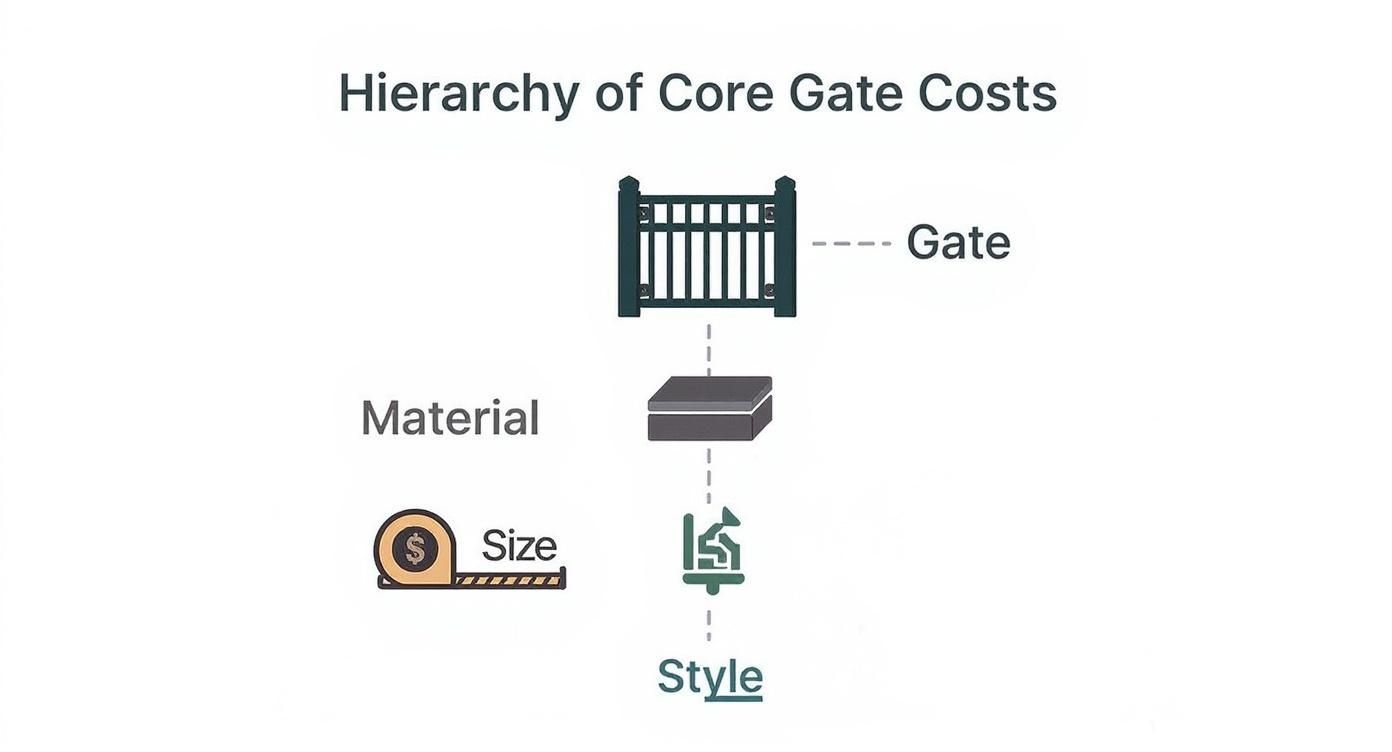
The gate's material, size, and style form the foundation upon which the automation system's power and complexity are built.
Choosing Your Access Method
How you command your gate to open is a key cost factor, balancing convenience, security, and budget.
- Remote Clickers: The most basic option. Cost-effective but offer minimal security if lost.
- Numeric Keypads: A popular choice for homes and businesses. A quality, weatherproof keypad adds $250 to $650 to the project cost, providing secure, code-based access.
- Telephone Entry & Intercom Systems: Essential for screening visitors. These systems range from $700 for a basic audio unit to over $5,000 for advanced video models suitable for multi-tenant commercial properties.
- Vehicle Detection Loops & Sensors: In-ground loops or photo-eye sensors that trigger the gate automatically are critical for managing exit traffic flow, especially in commercial settings. Installation typically costs $300 to $1,500.
Mandated Safety and Compliance Costs
Safety is a non-negotiable, mandated investment. Every professional automatic gate installation in Texas and Oklahoma must comply with UL 325 safety standards.
The UL 325 standard mandates that automated gates feature at least two independent safety mechanisms (e.g., photo-eye sensors, reversing edges) to prevent entrapment. Failure to comply poses a significant safety risk and liability exposure.
These safety devices are fundamental to a professional installation. Factoring them into your budget ensures your gate is not only functional but also safe and legally compliant—protecting your family, employees, and assets. This is a primary reason why professional gate installation services are a critical investment.
Ready to design a system for your home or business? We offer a variety of custom gate solutions to fit any need. And if you ever have issues down the road, our expert gate repair team is here to help.
Why Professional Installation Is a Critical Investment
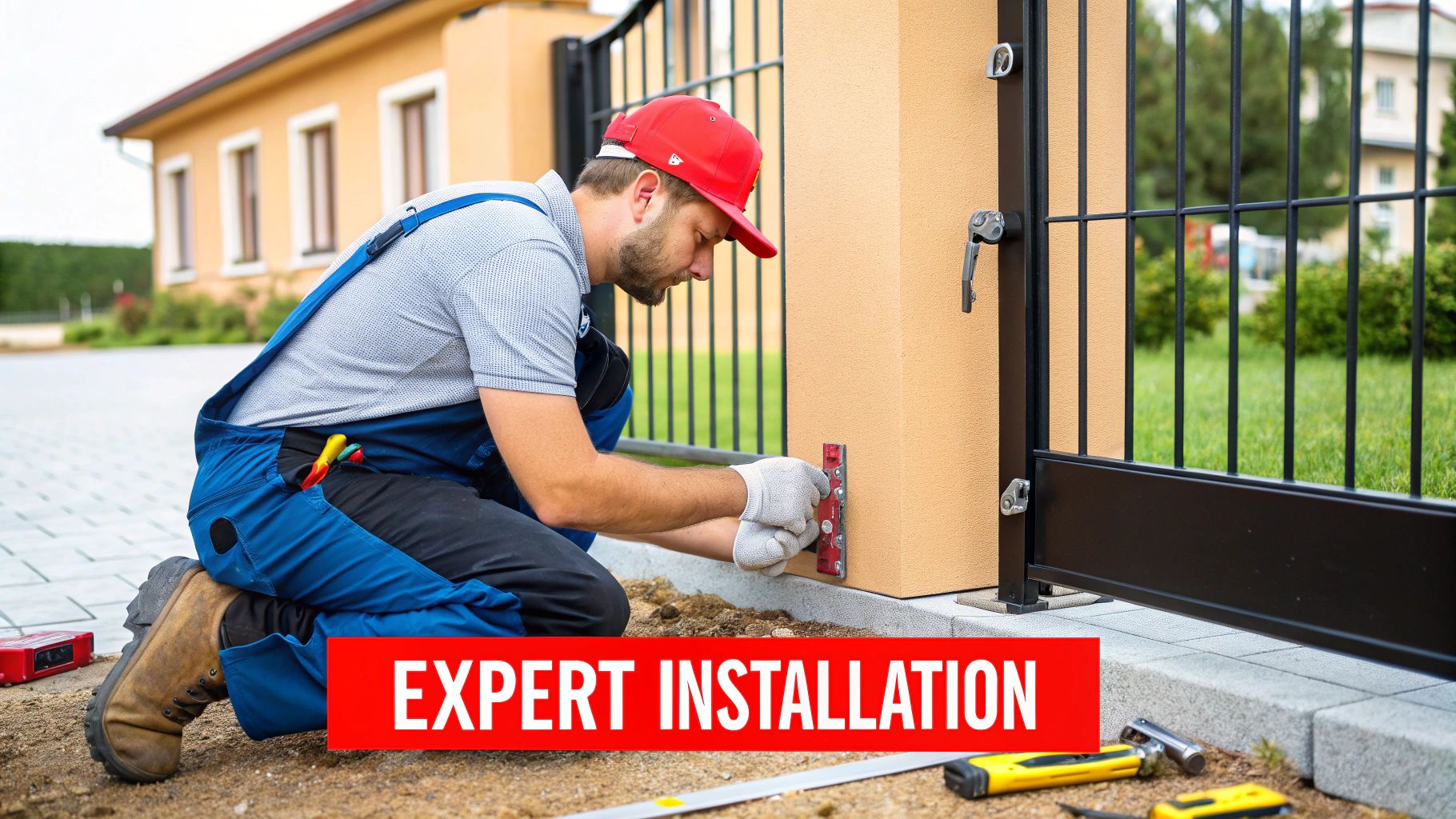
While DIY gate kits are available, the labor component of an automatic gate installation cost is an investment in safety, longevity, and code compliance. A professional's quote encompasses the meticulous details that prevent costly failures.
The process begins with proper site preparation and the creation of concrete footers—the unseen foundation engineered to bear the gate's static weight and dynamic operational forces for over a decade.
Industry Benchmark: A poorly set gate post is the leading cause of premature operator failure and gate misalignment. Professional installation ensures footings are dug below the frost line and sized appropriately for soil conditions and gate weight, preventing sagging that can cost thousands to repair later.
Precision in Every Detail
Once the foundation is set, professionals use specialized tools to ensure the gate is perfectly plumb and level. A deviation of even a quarter-inch can cause binding, placing immense strain on the operator's motor and gears, leading to a service life reduction of up to 50%.
The most critical phase is the electrical wiring. A licensed technician ensures all connections are safe, weatherproof, and compliant with the NFPA 70 National Electrical Code. Improper wiring is a primary cause of operator malfunction and poses a significant fire and electrical shock hazard.
The Value of Vetted Expertise
Hiring a licensed and insured installer is your best protection against liability. It verifies the technician's expertise in crucial safety protocols, including the UL 325 standards. An experienced team has the foresight to address site-specific challenges—from drainage issues to complex wiring runs—ensuring the system operates reliably from day one. You can see parallels in the considerations between DIY and professional installation for other major home projects.
Actionable Tip: Before hiring, ask any potential installer for their license number, proof of insurance, and examples of similar projects. A quote that is significantly lower than competitors often indicates cut corners on materials, safety compliance, or insurance.
Investing in a quality installation team is the most effective way to protect your property and your investment. For a closer look at what our professional process entails, check out our dedicated gate installation services.
How Market Trends Affect Your Gate Price
The quote you receive for an automatic gate installation cost is not set in a vacuum; it is influenced by regional and global economic forces. Understanding these factors makes you a more informed consumer.
The price of raw materials like steel and aluminum fluctuates based on global supply, demand, and energy costs. A 10% increase in steel prices, for instance, can translate to a 3-5% increase in the total cost of a steel gate project.
The Global Puzzle of Gate Electronics
Modern gate operators are complex electronic devices with components sourced globally. The recent global microchip shortage, for example, caused production delays and price increases of 15-25% for many gate operator models.
This complex supply chain means a disruption anywhere—from a factory shutdown to a shipping bottleneck—can impact availability and cost in Texas and Oklahoma. Furthermore, U.S. trade policies and tariffs on imported electronic components or hardware directly affect manufacturer pricing, and these costs are ultimately passed on to the consumer. Industry analysis from sources like 360iResearch details these global pricing pressures.
By understanding these market dynamics, you can interpret quotes with confidence, recognizing that a price increase may be tied to real-world economic shifts rather than arbitrary markups.
This insight allows for a more productive conversation with your installer about material availability and project timelines. A professional can help you navigate these trends, perhaps by suggesting alternative materials or timing your gate installation to align with more favorable market conditions.
Thinking Ahead: Long-Term Maintenance and Repairs
The initial installation cost is just one part of the total cost of ownership. Proactive maintenance and budgeting for eventual repairs are crucial for maximizing the lifespan and value of your automatic gate system.
Think of your gate operator like the engine in your car. It has moving parts that require regular service to perform reliably for years. Proactive maintenance is the single most effective strategy to prevent unexpected, costly breakdowns.
What Goes Into a Good Maintenance Plan?
For residential and commercial properties in Texas and Oklahoma, a professional preventative maintenance visit typically costs $150 to $350. This investment can prevent repair bills that are 5-10 times that amount. A standard service includes:
- Lubrication: Proper lubrication of chains, hinges, and rollers reduces friction, the primary cause of premature wear.
- Hardware Inspection: Tightening fasteners, checking welds, and inspecting wheels for wear.
- Safety Feature Tests: Verifying that all UL 325 required safety devices, like photo-eyes and reversing edges, are functioning correctly.
- Cleaning and Alignment: Clearing debris from gate tracks and ensuring perfect alignment to reduce strain on the operator.
Industry Data: A well-maintained automatic gate system has an average service life of 15 to 20 years. Systems with deferred maintenance often experience critical failures in as little as 5 to 7 years.
Budgeting for the Inevitable: Common Repairs
Even with diligent maintenance, components will eventually wear out. Being prepared for these costs prevents financial surprises.
Repair costs vary widely. Replacing a single photo-eye sensor might cost $200-$300. However, replacing a failed main control board or a burned-out motor on a residential operator can range from $600 to $1,200, including labor. For commercial systems, these costs can be significantly higher. Structural damage from a vehicle impact can easily lead to repairs costing several thousand dollars.
Actionable Tip: Set aside a small annual budget—around 1-2% of the initial installation cost—for maintenance and potential repairs. This ensures you're prepared when service is needed.
Understanding these long-term costs highlights the value of investing in high-quality components and professional upkeep from the start. Learn more about our comprehensive gate repair solutions to see how we help protect your investment.
Common Questions About Gate Installation Costs
Let's address the most frequent questions we receive from property owners across Texas and Oklahoma to help you plan your project with clarity.
How Much Does a Basic Driveway Gate Cost in Texas?
For a standard residential driveway, a basic automatic gate system—typically a 12-foot aluminum single-swing gate with a reliable operator—starts around $3,000 to $4,500 installed. This provides a significant boost in security and curb appeal at an accessible price point.
For more robust needs, such as a heavier steel gate, a wider opening requiring a double gate, or a sliding gate for a sloped driveway, the budget typically falls in the $5,000 to $9,000 range.
Is a Solar Gate Opener a Good Way to Save Money?
Yes, particularly for rural or large properties common in Texas and Oklahoma. While the solar-ready operator and panel may add $500 to $1,000 to the initial hardware cost, the savings on installation can be substantial.
You eliminate the need for electrical trenching, which can cost $15-$30 per linear foot. For a gate 200 feet from a power source, that's a savings of $3,000-$6,000 on trenching alone. Plus, you benefit from lower electricity bills and operational reliability during power outages.
Practical Benefit: During severe weather events in Texas or Oklahoma that cause power grid failures, a solar-powered gate remains fully functional, ensuring you can always get in or out of your property.
Do I Need a Permit to Install an Automatic Gate?
In most cases, yes. Municipalities like Dallas, Fort Worth, and Oklahoma City almost always require a permit, especially if the installation involves new electrical work or is near a public right-of-way.
This is a critical area where a professional installer provides immense value. They are versed in local building codes and will manage the entire permitting process, ensuring your installation is fully compliant, safe, and free from potential fines or legal issues.
At Overhead Door Co. of Tex-Oma, we are committed to providing transparent, data-driven guidance for your gate project. When you're ready to explore options, our team will provide a detailed quote tailored to your specific needs, ensuring the perfect balance of security, style, and long-term value.
- Get started with our expert Gate Installation services.
- Explore our wide range of Custom Gate Solutions.
- Plan for the future with our reliable Gate Repair and maintenance programs.