
When your garage door grinds to a halt, a broken spring is the most common culprit. It's a critical failure that immobilizes the heaviest moving part of your home or business. Naturally, the first question is always, "What's the garage door spring replacement cost going to be?"
For homeowners across Texas and Oklahoma, a professional torsion spring replacement typically ranges from $315 to $554. This all-inclusive price covers the high-cycle replacement springs, certified labor, and the service call. However, several factors, from your door's weight to the spring type, will influence the final invoice. This guide breaks down the data and industry benchmarks to give you a clear, actionable understanding of the costs involved.
A Data-Driven Breakdown of Spring Replacement Costs
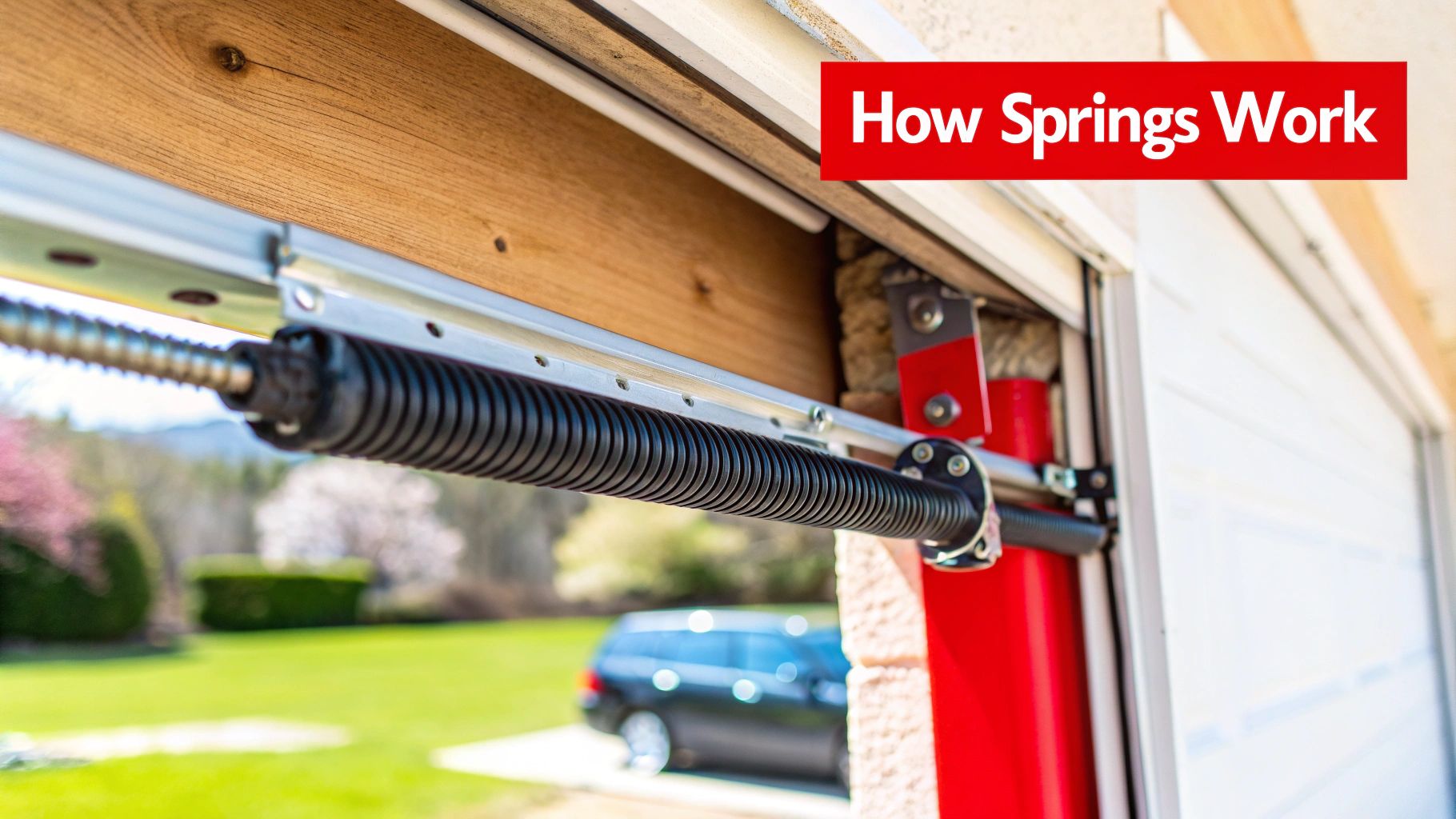
A broken garage door spring isn't an inconvenience; it's a significant safety issue. The springs are the counterbalance system, doing the heavy lifting of a door that can weigh over 400 pounds. When they fail, the door becomes a dead weight, making professional repair essential. Attempting a DIY repair is extremely dangerous due to the immense tension stored in the springs.
To understand what you're paying for, you have to look at the total value, not just the part cost. The final bill is a combination of high-quality parts, the technician's expertise and time, and operational costs. Let's analyze the components.
A Transparent Cost Breakdown
Industry data provides a clear picture of the costs. National averages for a residential garage door spring replacement—including labor and parts—range from $315 to $554 per spring. This price is influenced by factors like the door's size, weight, and regional labor rates in Texas and Oklahoma. The torsion springs themselves typically cost between $96 and $112 for a standard, 10,000-cycle spring. For a deeper dive, you can explore a detailed cost analysis of these maintenance expenses to see how national averages are calculated.
Actionable Tip: When getting a quote, ask the technician to explain their cost structure. A reputable company will transparently break down the costs for parts, labor, and the service fee. This isn't just about a "quick job"; you are paying for a technician's expertise in handling components under extreme tension, a process that requires specialized tools and adherence to safety protocols to prevent serious injury.
To provide clarity, here is a line-item breakdown of typical costs for a single torsion spring replacement. This table illustrates where your investment goes when you hire a certified professional for your residential garage door repair services.
Estimated Cost Breakdown for Single Torsion Spring Replacement
This table shows a line-item breakdown of the typical costs involved in a professional garage door spring replacement, based on industry averages.
| Cost Component | Low-End Estimate | High-End Estimate | Notes |
|---|---|---|---|
| Torsion Spring (Part Only) | $96 | $112 | Based on a standard 150 lb, 10,000-cycle spring. |
| Professional Labor | $150 | $300 | Varies by location (e.g., Dallas vs. rural Oklahoma). |
| Service Call & Disposal Fee | $69 | $142 | Covers travel, vehicle costs, and responsible disposal. |
| Total Estimated Cost | $315 | $554 | Final cost depends on your door's specific needs. |
As the data shows, the part itself is only a fraction of the total cost. The majority covers the skilled labor and operational expenses required to dispatch a qualified technician to perform the repair safely and efficiently.
Torsion vs. Extension Springs and How They Affect Your Price
The type of spring system your garage door uses is a primary factor in determining the replacement cost. The two main types are torsion springs and extension springs. Understanding their differences is key to deciphering your repair quote.
A torsion spring is a robust, coiled spring mounted on a steel shaft directly above the door opening. It works by twisting (or "torque"), providing a smooth, controlled lift. In contrast, extension springs run along the sides of the door tracks, stretching and contracting like massive elastic bands to lift the door.
While both perform the same function, their design, durability, safety, and cost differ significantly.
Why Torsion Springs Are the Industry Standard
In Texas and Oklahoma, professional installers almost exclusively recommend and install torsion spring systems. Their robust design is engineered to handle the significant weight of modern insulated steel or solid wood garage doors.
While the upfront replacement cost for a torsion system is slightly higher, it is a superior long-term investment. A standard torsion spring is rated for 10,000 to 15,000 cycles (one cycle = one open and one close). Extension springs, by comparison, typically only last for 5,000 to 10,000 cycles. This superior lifespan means fewer service calls and lower long-term ownership costs.
This infographic provides a visual breakdown of how costs for parts and professional labor compare between the two systems.
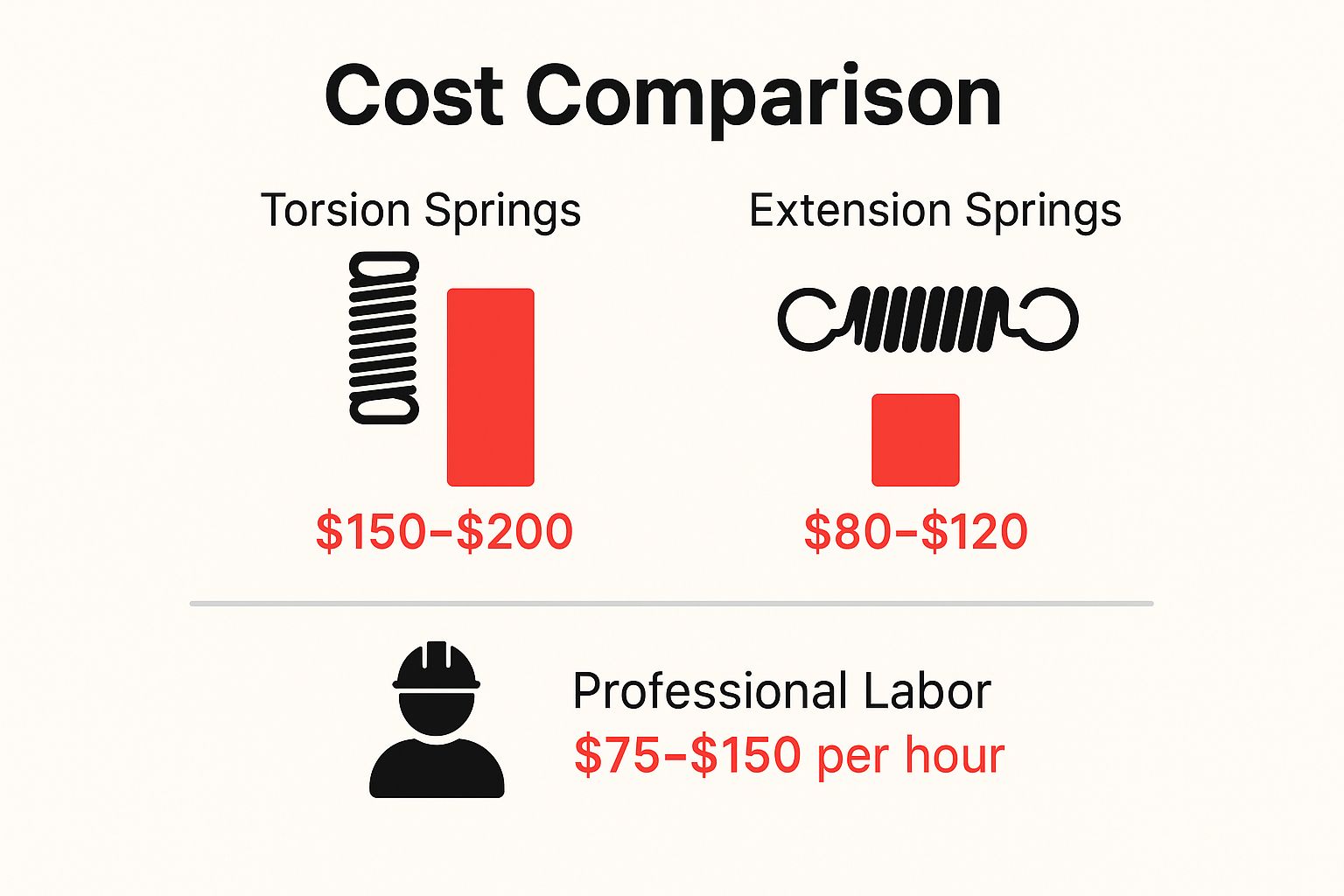
While torsion spring parts are more expensive, their enhanced lifespan and integrated safety features provide greater value and peace of mind. When a spring breaks, it's critical to seek prompt, professional garage door repair to prevent further damage to the system, such as a burnt-out opener motor or bent door panels.
A Head-to-Head Comparison
To clarify the choice, this table compares the two spring types based on cost, performance, and safety benchmarks.
Comparing Torsion and Extension Spring Replacement
| Feature | Torsion Springs | Extension Springs |
|---|---|---|
| Average Cost | $250 – $450 (including labor) | $200 – $350 (including labor) |
| Lifespan | 10,000 – 15,000 cycles | 5,000 – 10,000 cycles |
| Safety | Safer; contained on the torsion bar | Higher risk; can fly off if not cabled |
| Operation | Smooth, balanced, and quiet | Can be jerky and louder |
| Ideal For | Heavier, wider, or custom doors | Lighter, single-car garage doors |
The data shows a clear trade-off. Extension springs may offer a lower initial cost, but torsion springs deliver superior performance, safety, and a longer service life.
The Bottom Line on Cost and Value
The final bill for your spring replacement will be directly tied to which system you have. A full torsion spring replacement job usually lands somewhere between $250 to $450. Extension spring jobs are often a bit cheaper, starting around $200, but they come with a catch. They are considered less safe and don't last as long; according to industry best practices, they must be installed with safety cables to prevent them from becoming dangerous projectiles upon failure.
Most reputable installers will offer a 3–4 year warranty on new springs. This is a huge factor for long-term value, giving you peace of mind that your investment is protected.
Key Takeaway: Choosing torsion springs is an upfront investment in the safety, durability, and smooth operation of your garage door. While the initial cost is higher, you'll make it back with a longer lifespan and fewer repair calls down the road.
Key Factors Influencing Your Final Invoice
Beyond the spring type, several variables shape the final number on your invoice. Understanding these helps you recognize a fair and accurate quote. The most significant factor is the size and weight of your garage door. A standard single-car aluminum door requires much less lifting force than a heavy, double-wide insulated steel or solid wood door. Greater weight demands larger, higher-gauge springs, which are more expensive.
Why Professionals Replace Springs in Pairs
This is a frequent and logical question: if only one spring broke, why replace both? The answer is rooted in safety and mechanical best practices. Garage door springs are installed as a matched set and endure the exact same number of cycles. When one fails due to metal fatigue, the other is invariably near the end of its operational life.
Replacing only the broken spring creates a dangerous imbalance. The new spring bears most of the load, causing excessive wear on both the spring and the garage door opener. This can lead to jerky operation and premature failure of the opener's motor. Therefore, professional technicians always replace springs in pairs to ensure the system is properly balanced, safe, and reliable.
This industry-standard practice ensures your door is perfectly balanced and operates smoothly, saving you from a second, inevitable service call just a few weeks or months later. It’s a critical safety step that ends up being far more cost-effective in the long run.
Labor Costs and Service Timing
Labor rates are the other major component of your bill. Hourly charges in a major metro area like Dallas will differ from those in rural parts of Texas or Oklahoma, reflecting local business operating costs. The timing of your service request also matters. A standard appointment during business hours is the most economical option. Emergency service requests for nights, weekends, or holidays will incur a premium charge for after-hours availability.
For a benchmark, recent industry data shows the total garage door spring replacement cost for a standard door typically lands somewhere between $160 and $350. Of that total, the labor portion usually accounts for $75 to $150. You can explore these consumer cost reports to get a feel for national averages.
Commercial vs. Residential Springs: A Different League Entirely
While a broken spring at home is an inconvenience, a failure on a commercial overhead door can halt business operations, impacting safety and revenue. For businesses in Texas and Oklahoma, it is critical to understand that the garage door spring replacement cost for commercial applications is substantially higher and governed by different standards.
The operational demands are vastly different. A residential garage door may weigh a few hundred pounds and cycle 2-4 times per day. A commercial roll-up door at a loading dock can weigh over 1,000 pounds and cycle dozens of times per hour. These are industrial-grade systems requiring specialized hardware.
Why Commercial Spring Jobs Have a Higher Price Tag
Commercial doors utilize high-cycle torsion springs engineered for continuous, heavy-duty use. A standard residential spring is rated for about 10,000 cycles. Commercial-grade springs, however, are rated for 50,000, 75,000, or even 100,000 cycles to meet the demands of a busy facility and minimize downtime.
The repair process itself is more complex and hazardous. Technicians often require specialized equipment, such as scissor lifts or scaffolding, to safely access and manage the massive spring assemblies. This necessary equipment is factored into the project's overall cost.
Industry Insight: Commercial door repairs are governed by strict safety regulations. All work must comply with Occupational Safety and Health Administration (OSHA) standards, such as lock-out/tag-out procedures (OSHA 1910.147), to protect technicians and on-site employees. This level of compliance requires additional time and procedural steps, which contributes to the higher cost.
Breaking Down the Key Differences
It's one thing to hear the jobs are different; it's another to see it side-by-side. One is a standard home repair, while the other is a specialized industrial service. For businesses thinking about new installations or a major overhaul, looking into the variety of commercial doors available can help you plan for long-term maintenance needs from the start.
Here’s a clear breakdown of why the costs are so different:
- Door Size and Weight: A home's 16×7 foot door might be 300 lbs. A commercial door could be 24×16 feet and weigh over a thousand pounds.
- Spring Type and Cost: Commercial springs are forged from thicker, more resilient steel to achieve that high-cycle rating, making the parts themselves significantly more expensive.
- Labor and Equipment: A commercial job demands certified technicians, heavy lifting gear, and more hours on-site, which drives up the labor charges.
- Safety and Compliance: Adhering to OSHA regulations is not optional. It requires specific procedures and documentation that add a necessary layer to the project's scope and cost.
The Hidden Dangers of a DIY Spring Replacement
While many home repairs are suitable for a DIY approach, garage door spring replacement is not one of them. The garage door spring replacement cost is a small price to pay for personal safety. The immense tension stored in a wound torsion spring can be lethal if released improperly. This is not hyperbole; it is a matter of physics. A fully wound spring contains enough kinetic energy to cause severe injury or property damage.
The Real Risks of Going It Alone
When a DIY spring replacement fails, it fails catastrophically. An attempt to save money can result in an emergency room visit and far greater repair costs.
Without professional training and specialized tools, the risks include:
- Severe Lacerations and Amputations: If a spring breaks during winding or a tool slips, the spring can violently unwind, causing deep cuts or severing digits.
- Flying Projectiles: This is the most common cause of serious injury. Using improper tools like screwdrivers or rebar instead of hardened steel winding bars can lead to the tool being ejected with tremendous force.
- Sudden Door Collapse: Incorrectly releasing spring tension will cause the full weight of the door to drop instantly, crushing anything in its path.
Safety Standard: Professionals use winding bars, which are specifically designed from hardened steel to fit securely into the spring's winding cone. This allows them to safely control the stored energy during adjustment. Using any other tool is the leading cause of severe DIY injuries.
An Investment in Safety and Security
Hiring a professional is an investment in safety and peace of mind. Our technicians possess the correct equipment, extensive training, and are fully insured. They have performed this repair thousands of times and understand how to manage these high-tension systems safely, protecting your family and property from a preventable accident.
To learn about proactive maintenance for other parts of your system, see our guide on common garage door problems and solutions. But for spring replacement, always trust a certified expert.
Finding a Reputable Garage Door Company in Texas and Oklahoma
Knowing the cost data is half the battle; finding a qualified and trustworthy company is the other. The technician you hire directly impacts the safety, reliability, and quality of the repair. A smart hiring decision ensures your garage door spring replacement cost is an investment in long-term performance.
Your first step should be to verify licensing and insurance. A professional company will readily provide proof of general liability insurance and worker’s compensation coverage. This documentation protects you from financial liability in the event of an on-site accident. Next, investigate their local reputation. Check recent online reviews from customers in your specific Texas or Oklahoma community. Local feedback on punctuality, professionalism, and workmanship is invaluable.
Your Vetting Checklist
Use this checklist to vet potential companies and ensure you hire a top-tier professional:
- Demand a Written Estimate: Never accept a verbal quote. A true professional will inspect the door and provide a detailed, itemized estimate that separates costs for parts, labor, and any service fees.
- Ask About Warranties: A reputable company guarantees its work. Inquire about the warranty for both the springs (parts) and the installation (labor). A 3-4 year warranty on high-quality springs is a strong indicator of quality.
- Verify Their Physical Address: A legitimate business has a physical presence in the community. Be cautious of companies that only list a P.O. box. You want a local team you can easily contact if issues arise.
Actionable Tip: Beware of the hard sell. A trustworthy technician will educate you on your options, focusing on the safest and most effective solution. They will not pressure you into unnecessary and expensive upgrades.
Look for a company with an established presence in your region. Knowing their specific service areas in Texoma demonstrates a commitment to local homeowners and businesses. Following these steps will help you find a qualified pro who will perform the job correctly, safely, and at a fair price.
Your Top Questions About Garage Door Spring Costs Answered
Even with all the numbers laid out, you probably still have a few practical questions swimming around. That's completely normal. Let's tackle some of the most common ones we hear from homeowners in Texas and Oklahoma so you can feel confident about your decision.
Should I Replace Both Springs at the Same Time?
The short answer? Yes, always. It might seem like a way to save a few bucks now, but only replacing the one broken spring is a classic case of being penny-wise and pound-foolish.
Think of it this way: both springs were installed on the same day and have lifted and lowered your heavy door the exact same number of times. If one just snapped from fatigue, its partner is living on borrowed time. A new spring paired with an old, worn-out one creates a serious imbalance, putting incredible stress on the new spring, your opener, and the door itself. It's not just inefficient; it's unsafe.
Replacing both at once is the professional standard for a reason. It ensures a balanced, safe system and saves you the cost and hassle of a second service call just a few weeks or months down the road.
How Long Do Garage Door Springs Actually Last?
A spring's lifespan isn't measured in years, but in cycles. One cycle is one full open-and-close motion of your garage door.
Standard-issue torsion springs are usually rated for 10,000 cycles. If your family uses the garage door, say, four times a day, you can expect that spring to last somewhere in the ballpark of 7 years. For homes with a lot of traffic or for those who simply want a longer-lasting solution, you can upgrade to high-cycle springs. These workhorses can be rated for 50,000 cycles or even more.
While you're thinking about home repairs, it's natural to consider how to protect yourself from other unexpected expenses. If you're curious about how broader protection plans work for major appliances and systems, you can learn more about what a home warranty covers.
For a safe, reliable, and honestly priced spring replacement anywhere in our Texas and Oklahoma service areas, put your trust in the experts at Overhead Door Co. of Tex-Oma. Get in touch with us today for a professional inspection and a clear, detailed estimate.