
While many commercial overhead door sizes are custom-built for specific operational needs, key industry benchmarks provide a solid starting point. For loading docks, doors are often 8'W x 10'H or 9'W x 10'H. For general warehouses and automotive shops, common sizes range from 10'W x 10'H and 12'W x 12'H up to 14'W x 14'H.
Getting the size right is more than just a measurement—it’s a critical decision for the operational efficiency and safety of any business in Texas or Oklahoma. An incorrectly sized door can lead to workflow bottlenecks, increased energy costs, and significant safety risks.
Your Guide to Standard Commercial Door Sizes
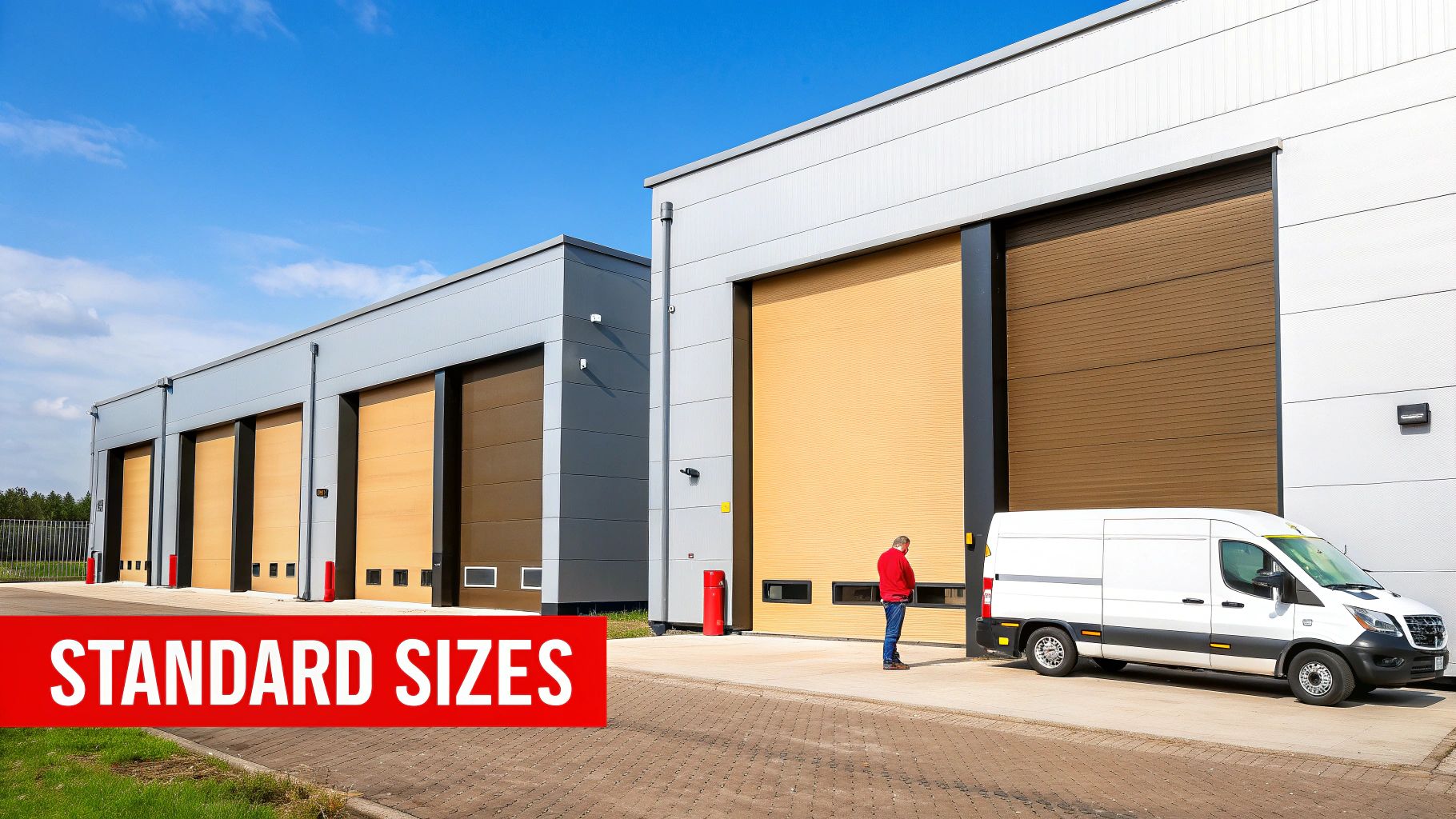
Choosing the right commercial overhead door isn't just about filling an opening. It’s a strategic choice that directly impacts daily workflow, energy costs, and security. Unlike residential doors, which come in a few standard sizes, commercial applications are highly specialized. A door's dimensions are dictated entirely by the function of the facility.
For example, a loading dock in Dallas needs a door that creates a tight seal with a semi-trailer to protect goods and maintain climate control. Meanwhile, an auto repair shop in Lawton requires a door tall enough to clear vehicles on service lifts.
Industry-standard sizes exist to provide a baseline, streamlining manufacturing and installation. Think of these standards as a starting point, not a restrictive rule.
Factors That Determine the Right Door Size
Before you can settle on a size, you need to consider a few key variables. Getting this right from the start saves a lot of headaches down the road.
- Vehicle Types: What is the largest vehicle that will pass through the door? You must account for the height and width of delivery trucks, forklifts, or service vehicles your facility will accommodate.
- Operational Workflow: Consider the volume and frequency of traffic. A high-cycle dock door has different requirements than one used only occasionally for maintenance access.
- Building Codes: Local regulations in Texas and Oklahoma often have specific requirements for minimum opening sizes to ensure safety and accessibility, referencing standards like the International Building Code (IBC).
- Equipment Needs: Think about what’s happening inside. You’ll need to ensure there’s enough clearance for internal machinery, cranes, or other specialized equipment.
Nailing down these factors is the first step toward making a smart, informed investment that will serve your facility well for years to come.
Common Commercial Door Sizes by Application
To give you a practical idea of what's typical, here’s a quick-reference chart showing common door dimensions for different types of businesses.
| Application Type | Typical Width Range (ft) | Typical Height Range (ft) | Primary Consideration |
|---|---|---|---|
| Loading Docks | 8 – 10 | 9 – 12 | Accommodating standard semi-trailers (8'6" W) |
| General Warehouses | 10 – 14 | 10 – 16 | Forklift and pallet jack clearance |
| Automotive Repair Bays | 10 – 12 | 12 – 14 | Vehicle lift height and width |
| Agricultural Buildings | 16 – 24 | 14 – 18 | Large machinery like combines and tractors |
| Fire Stations / EMS | 12 – 14 | 14 – 16 | Rapid egress for emergency vehicles |
Actionable Tip: Always add at least one foot to the height and width of your largest vehicle to ensure safe clearance and prevent accidental damage.
Choosing the Right Door Size for Your Industry
When it comes to commercial overhead doors, one size definitely does not fit all. The right door isn't just about filling an opening; it's a critical piece of equipment tailored to the specific rhythm and demands of your industry. A local auto repair shop in Shawnee has completely different operational needs than a sprawling distribution hub in Dallas, and their doors have to reflect that. Getting the dimensions right from the start is fundamental to a smooth workflow, a safe environment, and ultimately, your bottom line.
For instance, a fire station needs doors wide and tall enough—often around 14 feet high—for fire engines to race out unimpeded. In contrast, an agricultural facility out in rural Oklahoma might need an exceptionally wide opening, sometimes over 24 feet, to easily move combines and other massive farm machinery.
Matching Door Dimensions to Business Functions
The best way to determine the right size is to think through your day-to-day operations. A manufacturing plant with constant forklift traffic needs a different solution than a self-storage facility designed for consumer vehicles.
- Logistics and Warehousing: These facilities are built around semi-trailers. Doors need to be at least 14 feet high to clear modern high-cube containers and ensure efficient loading and unloading.
- Automotive Services: Repair bays must account for vehicles on lifts. You'll typically see doors between 12 and 14 feet tall to give mechanics plenty of clearance to work safely and effectively.
- Retail and Service Bays: For businesses that receive smaller deliveries from box trucks or service vans, a standard 10-foot by 10-foot door is often the perfect fit.
Industry Benchmark: Market data reveals a clear trend toward larger doors, driven by modern supply chain demands. The North American overhead door market has seen a significant shift toward doors wider than 16 feet and taller than 14 feet, especially in new industrial construction, to accommodate palletized goods and heavy forklift use.
Ultimately, choosing the right door means planning for your largest vehicle, your busiest workflow, and your future growth. Investing in the correct commercial overhead door sizes upfront saves you from expensive retrofits and frustrating operational bottlenecks down the road. Explore our complete range of commercial doors to find the ideal solution for your business in Texas or Oklahoma.
How to Measure Your Door Opening Accurately
When it comes to commercial overhead doors, a small error with a tape measure can quickly turn into a multi-thousand-dollar mistake. Getting the right fit isn't just about the width and height of the opening; the two most critical (and most often forgotten) measurements are headroom and side room.
Headroom is the clear vertical space from the top of the door opening up to the ceiling or the first obstruction, like a pipe or ductwork. Side room is the clear horizontal space you have on either side of the opening. These areas are vital because they're where the door's tracks, springs, and operator mechanism will live. Without enough space, you might not be able to install the door you need.
Your Measurement Checklist
Before you make any calls or place an order, grab a steel tape measure and get these five key dimensions. It's best to avoid cloth or vinyl tapes, as they can stretch over time and throw off your numbers.
- Opening Width: Measure the widest part of the finished opening, from one side of the door jamb to the other.
- Opening Height: Measure from the finished floor to the bottom of the header at the tallest point of the opening.
- Headroom: Measure from the top of the door opening to the lowest point of any obstruction directly above. A standard lift door typically needs at least 15 inches of headroom.
- Side Room: Measure the clear, unobstructed space on the left and right sides of the opening. You'll generally need a minimum of 4.5 inches, but some systems require more.
- Backroom: Measure the clear distance from the door opening straight back into the building, ensuring the door has enough room to fully retract without hitting anything.
These dimensions are a fundamental part of a building's functional design, playing a key role in the overall commercial building's floor plan.
This infographic provides a great overview, connecting your industry and vehicle requirements directly to the final door size you'll need.
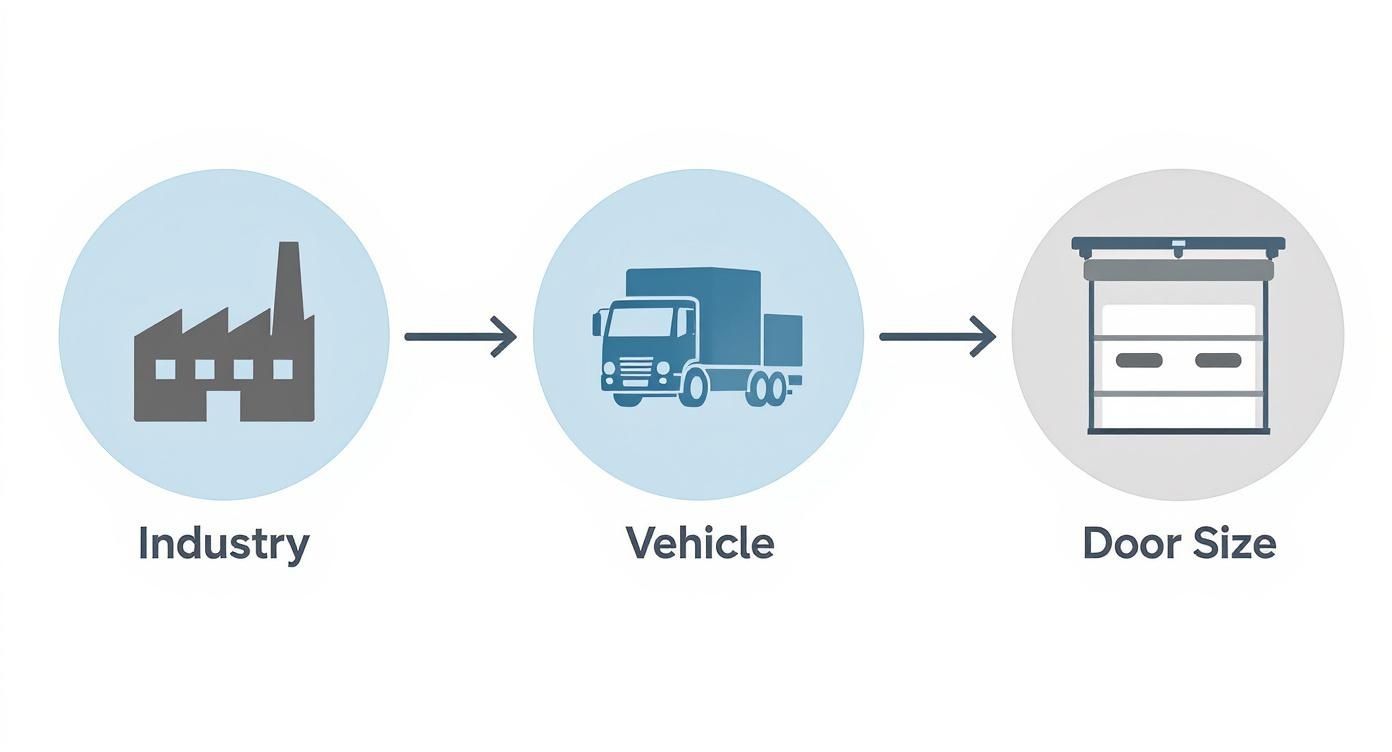
As you can see, your day-to-day operations dictate the physical dimensions of the door system. A simple measurement mistake can cause major operational headaches, safety risks, and even expensive re-framing work down the line.
Actionable Tip: While taking these measurements yourself gives you a solid starting point, nothing beats a professional site assessment. Our technicians ensure every dimension is spot-on, carefully accounting for things like uneven floors or structural quirks. You can learn more about the precision we bring to every job in our commercial door installation process for businesses throughout Texas and Oklahoma.
Impact of Material on Maximum Door Size
When you're spec'ing out a commercial overhead door, the material you choose is one of the biggest factors determining the maximum size you can get. It's all about the inherent structural properties of materials like steel, aluminum, and fiberglass—each has its own natural limits.
Take aluminum, for instance. It's wonderfully lightweight and fantastic for resisting corrosion, but it just doesn't have the brute strength needed for really wide openings. It's best reserved for smaller commercial applications where rigidity isn't the top priority.
Steel, on the other hand, is the undisputed champion for large-scale industrial doors. Its impressive strength-to-weight ratio allows it to span massive openings without sagging or losing its structural integrity. This is precisely why steel doors dominate the market for warehouses and other large facilities.
Material Selection for Texas and Oklahoma Climates
Here in Texas and Oklahoma, we have to think beyond just size—we have to consider the climate. The temperature swings can be dramatic, making insulation a critical feature. For any climate-controlled space like a warehouse or manufacturing plant, an insulated steel door with a high R-value is almost always the right call to reduce energy consumption.
Just remember, that insulation adds both weight and thickness, and you have to account for that when calculating the door's maximum size and the required hardware.
Data Point: The global garage and overhead doors market reached USD 6.79 billion in 2021. Steel doors captured the largest market share, largely because of their strength, durability, and suitability for extra-wide industrial installations.
It’s also crucial to be familiar with local building codes, as they often have specific requirements that influence material choice and door size. Getting an expert involved is the best way to make sure your choice ticks all the boxes, both for your operations and for regulatory compliance.
Sizing Doors for High-Traffic Loading Docks
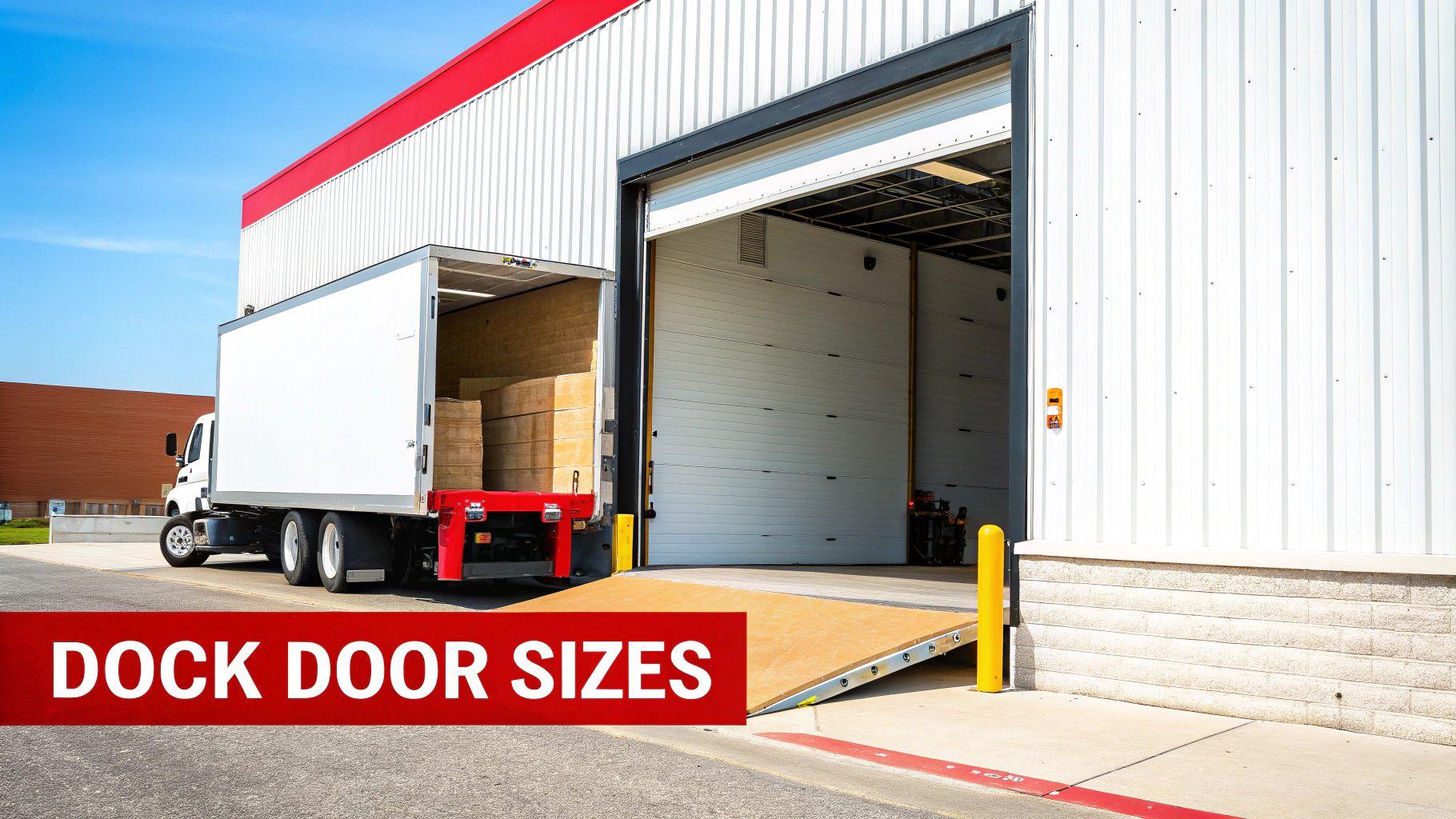
For any warehouse or distribution center in Houston, Dallas, or Oklahoma City, the loading dock is the facility's logistical heart. Getting the door sizing right here is absolutely critical—it directly impacts productivity, team safety, and energy bills. A door that's even a little too small can create major bottlenecks, while an oversized door is inefficient to operate and heat.
When it comes to high-traffic loading docks, the industry has landed on a couple of standard sizes for a reason. You'll most often see doors that are 8 feet wide by 10 feet high or 9 feet wide by 10 feet high. These dimensions have become the go-to because they're perfectly suited to handle the wide variety of semi-trailers out there, from standard dry vans to taller refrigerated units, ensuring a tight fit for loading and unloading.
Beyond the Basic Opening
But here's something experienced facility managers know: the final door size isn't just about the rough opening. You have to account for the other essential equipment that makes a loading dock work, as it all has to function together as one cohesive unit.
- Dock Levelers: These mechanical plates bridge the gap between the dock floor and the truck bed. The specific type and size of your leveler will directly influence the required height of your door opening.
- Dock Seals and Shelters: These cushioned or inflatable pads press against the trailer, creating a seal from the outside elements. Your door needs to be sized to work in tandem with these systems to stop energy loss and protect your goods from rain, wind, and debris.
Industry Standard: According to OSHA guidelines, maintaining a safe and clear loading dock area is paramount. A properly sized door that integrates with dock equipment helps prevent accidents by ensuring stable and secure transfer of goods between the dock and the trailer.
Think of the door, the seal, and the leveler as a single, integrated system. Investing in the right commercial door accessories is what ensures the whole setup operates flawlessly. For a deeper dive into common industry sizes, you can find helpful information in market research on North American overhead doors.
Custom Doors for Specialized Operations
Sometimes, standard door sizes just don't cut it. If you're dealing with aircraft hangars, massive agricultural machinery, or sprawling manufacturing bays, you need a door built specifically for the job. These applications demand more than just a bigger door; they require a solution engineered for immense scale, strength, and technical precision.
The design process for these doors is far more involved than simply measuring an opening. Here in Texas and Oklahoma, one of the most critical factors is the wind load rating. Engineers must perform complex calculations based on ASCE 7 standards to determine the maximum wind force a door can withstand, ensuring it won't fail during the severe weather we often experience. This is crucial for protecting your facility's structural integrity and your team.
Advanced Systems for Strength and Safety
It's not just about the door panel itself. A custom door's operating system has to be just as robust. Think about the sheer size and weight of a door on an aircraft hangar—it needs incredibly powerful motors and specially designed tracks to operate smoothly and reliably day in and day out.
Safety Standard: Every custom-engineered system must adhere to strict safety standards like UL 325, which sets the benchmark for the safe operation of door systems. This standard mandates features like photo-eye sensors and reversing mechanisms to prevent accidents and protect your team.
This detailed engineering ensures your door isn't just a perfect fit for the opening, but a safe, long-lasting asset for your unique operation. To see what's possible for a challenging industrial space, take a look at our gallery of custom overhead door solutions.
Common Questions About Commercial Door Sizes
Getting your commercial door measurements right is a big deal. It affects everything from daily operations to long-term costs. Here are some straightforward answers to the questions we hear most often from business owners across Texas and Oklahoma.
What’s the Most Common Commercial Overhead Door Size?
There’s no single "standard" size, as it depends entirely on the application. For loading docks, the most popular dimensions are 8 feet wide by 10 feet high and 9 feet wide by 10 feet high.
For general-purpose warehouses or automotive service bays, sizes like 10'x10', 12'x12', and 14'x14' are extremely common because they can accommodate a wide variety of vehicles and equipment.
How Much Headroom Do I Need for a Commercial Door?
Headroom—the clear space from the top of the door opening to the ceiling—is a critical measurement that dictates the type of track system you can use.
- Standard Lift Tracks: A typical setup requires approximately 15 to 18 inches of headroom to operate properly.
- High-Lift or Vertical-Lift Tracks: If you need the door to go straight up the wall to clear interior obstacles, you'll need a specialized track system. These can require several feet of clearance above the opening, depending on the door's height.
It's absolutely essential to get this measurement right. An incorrect headroom calculation can bring your entire installation to a halt.
Can I Install a Wider Door in My Existing Opening?
Yes, widening an existing opening is usually possible, but it is a major structural modification, not a simple swap.
The project involves altering the building’s frame, which includes cutting back the wall and installing a new, wider header and jambs. This work must be done by a qualified contractor to ensure the wall can safely bear the load of the larger, heavier door and that all modifications comply with local building codes.
Do Taller Doors Require Stronger Openers?
Without a doubt. Taller, wider, and heavier doors place much greater stress on the motor. You will need a robust, commercial-duty operator with the appropriate horsepower and torque rating for the job.
Matching the opener to the door's weight, size, and cycle count (how many times it opens and closes per day) is critical. Using an undersized operator is a recipe for premature failure and can create serious safety hazards.
If you need an expert opinion on the right commercial door size for your facility or want a professional site assessment, the team at Overhead Door Co. of Tex-Oma is here to help. Contact us today to make sure your business is set up for maximum efficiency and safety.
