
Your garage door is more than just an entry point; it's a massive, uninsulated moving wall that can be one of the largest sources of energy loss in your entire home or commercial building. According to industry data, an uninsulated garage door can shift the temperature in your garage by as much as 30°F compared to the outdoors. This thermal inefficiency forces your HVAC system to work overtime, inflating your utility bills.
Boosting your garage door energy efficiency is one of the smartest investments a property owner in Texas or Oklahoma can make. It directly impacts your bottom line and the comfort of your living or working space.
Why Your Garage Door is a Hidden Energy Drain
When considering energy savings, we often focus on windows or attic insulation, overlooking the single largest moving part of a building: the garage door. For anyone dealing with the intense Texas summers and sudden Oklahoma cold fronts, an uninsulated door is a significant structural weakness.
Think of an uninsulated metal door as a giant radiator. On a hot day, it absorbs solar heat, turning your garage into an oven that can easily exceed 120°F. This heat doesn't stay put; it conducts through shared walls and ceilings, forcing your air conditioner into a constant, losing battle. The U.S. Department of Energy notes that this kind of heat gain is a major driver of high cooling costs. In winter, the reverse happens as heated air escapes through the thin metal.
The Impact on Your HVAC System and Wallet
This constant thermal struggle puts immense strain on your HVAC system, leading to tangible consequences for both residential and commercial properties:
- Higher Energy Bills: According to the Department of Energy, heating and cooling account for nearly half of the energy use in a typical U.S. home. An inefficient garage door directly inflates this number.
- Increased Wear and Tear: Overworked HVAC systems experience more frequent breakdowns and have a shorter operational lifespan, leading to costly premature replacement.
- Inconsistent Comfort: Rooms adjacent to the garage often suffer from drafts or stuffiness due to temperature bleed-through.
According to data from door manufacturers, upgrading to an insulated garage door can reduce energy loss through the garage by up to 71%. In the Texas and Oklahoma climate, this often translates to a 5–10% reduction in annual heating and cooling costs, a significant return on investment.
More Than Just a Door
Improving your garage door is a critical part of a holistic energy strategy. For more insights into reducing your overall energy consumption, these practical home energy efficiency tips offer a broader perspective.
Understanding this energy loss makes it clear that a professional garage door installation isn't just an expense—it's a strategic upgrade that enhances comfort and delivers long-term savings.
Understanding R-Value and Insulation Materials
When discussing garage door energy efficiency, "R-value" is the industry-standard benchmark you need to know. It's a measure of thermal resistance—in simple terms, how well the door stops heat from passing through it.
A higher R-value provides better insulation. For the climate in Texas and Oklahoma, a door with a sufficient R-value is your primary defense against extreme temperatures. If your garage is attached to your home or is a conditioned commercial space, the R-value directly impacts the comfort of adjoining rooms and the load on your HVAC system.
This infographic illustrates how heat transfer through a poorly insulated door creates a chain reaction of wasted energy.
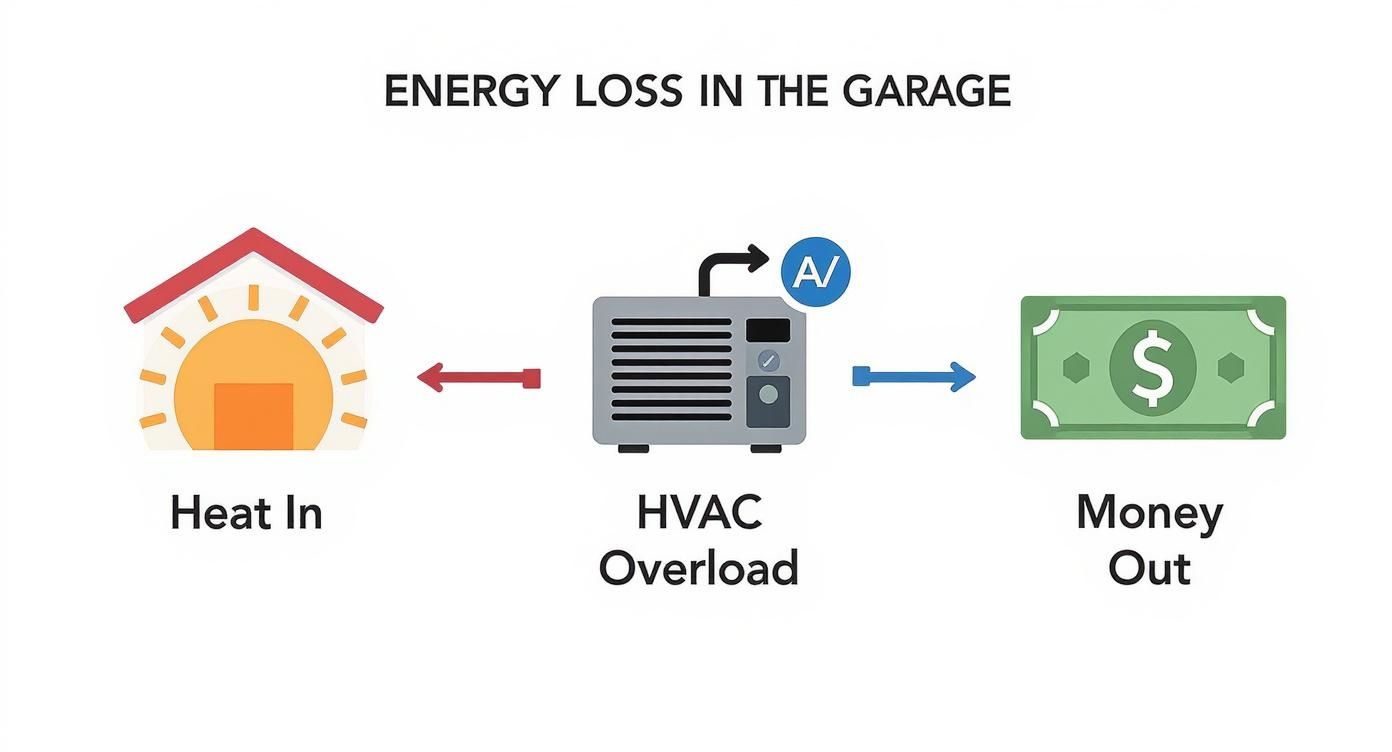
As shown, this uncontrolled heat transfer directly leads to higher utility bills.
Comparing Key Insulation Materials
The material inside your garage door panels determines its R-value. The two dominant technologies in the industry are polystyrene and polyurethane.
1. Polystyrene Insulation
This is a rigid foam board, similar to what's used in foam coolers. Manufacturers cut large sheets of expanded polystyrene (EPS) and fit them into the garage door panels.
- How it Works: It uses trapped air pockets within the foam to slow heat transfer.
- Performance: A cost-effective choice that provides respectable insulation, typically delivering R-values from R-2 to R-9.
- Best For: An excellent upgrade from a non-insulated door, offering a great balance of performance and value for homeowners and businesses.
2. Polyurethane Insulation
This is a thermally superior foam injected as a liquid into the door's cavity. It expands to fill every crevice before hardening, creating a seamless, airtight barrier.
- How it Works: Its dense, closed-cell structure is inherently better at blocking thermal transfer. The injection process eliminates air gaps, maximizing efficiency.
- Performance: This is the high-performance standard, offering nearly double the R-value per inch compared to polystyrene. Doors with polyurethane can achieve R-values from R-12 up to R-20+.
- Best For: For any property owner in Texas or Oklahoma serious about maximizing energy efficiency, noise reduction, and door strength, polyurethane is the superior choice.
Because polyurethane foam bonds directly to the steel skins of the door panels, it significantly increases structural rigidity and dent resistance. This makes the door operate more quietly and withstand the rigors of daily commercial or residential use.
To clarify the choice, here is a direct comparison.
Comparing Garage Door Insulation Materials
| Feature | Polystyrene Insulation | Polyurethane Insulation |
|---|---|---|
| R-Value per Inch | Lower (approx. R-3.8) | Higher (approx. R-6.5) |
| Manufacturing | Foam boards cut to fit | Injected foam that expands to fill |
| Coverage | Good, but can have air gaps | Excellent, fills all gaps |
| Door Strength | Minimal added rigidity | Significantly increases strength |
| Cost | More budget-friendly | Higher initial investment |
| Noise Reduction | Moderate | Superior |
While polystyrene is a solid upgrade, polyurethane is the clear leader for peak performance.
What R-Value Is Right for Texas and Oklahoma?
For our specific climate, finding the optimal balance of performance and cost is key. For most attached garages in our region, a door with an R-value between R-9 and R-13 is the recommended target.
This range provides a substantial thermal barrier that dramatically reduces heat gain in summer and heat loss in winter. It's a smart investment that delivers measurable results without paying a premium for an R-value designed for much colder climates. With energy costs on the rise, the payback period for a professionally installed, insulated door is often just a few years.
Browse our complete line of residential garage doors and accessories to find the ideal style and insulation level for your home's architecture and efficiency goals.
Reclaiming Your Garage as a Comfortable, Usable Space
An energy-efficient garage door delivers benefits far beyond lower utility bills. It transforms how you use a significant portion of your property. For homeowners and businesses in Texas and Oklahoma, this upgrade is the key to converting a space of extreme temperatures into a functional extension of your home or facility.
Think of it as an investment in usability.
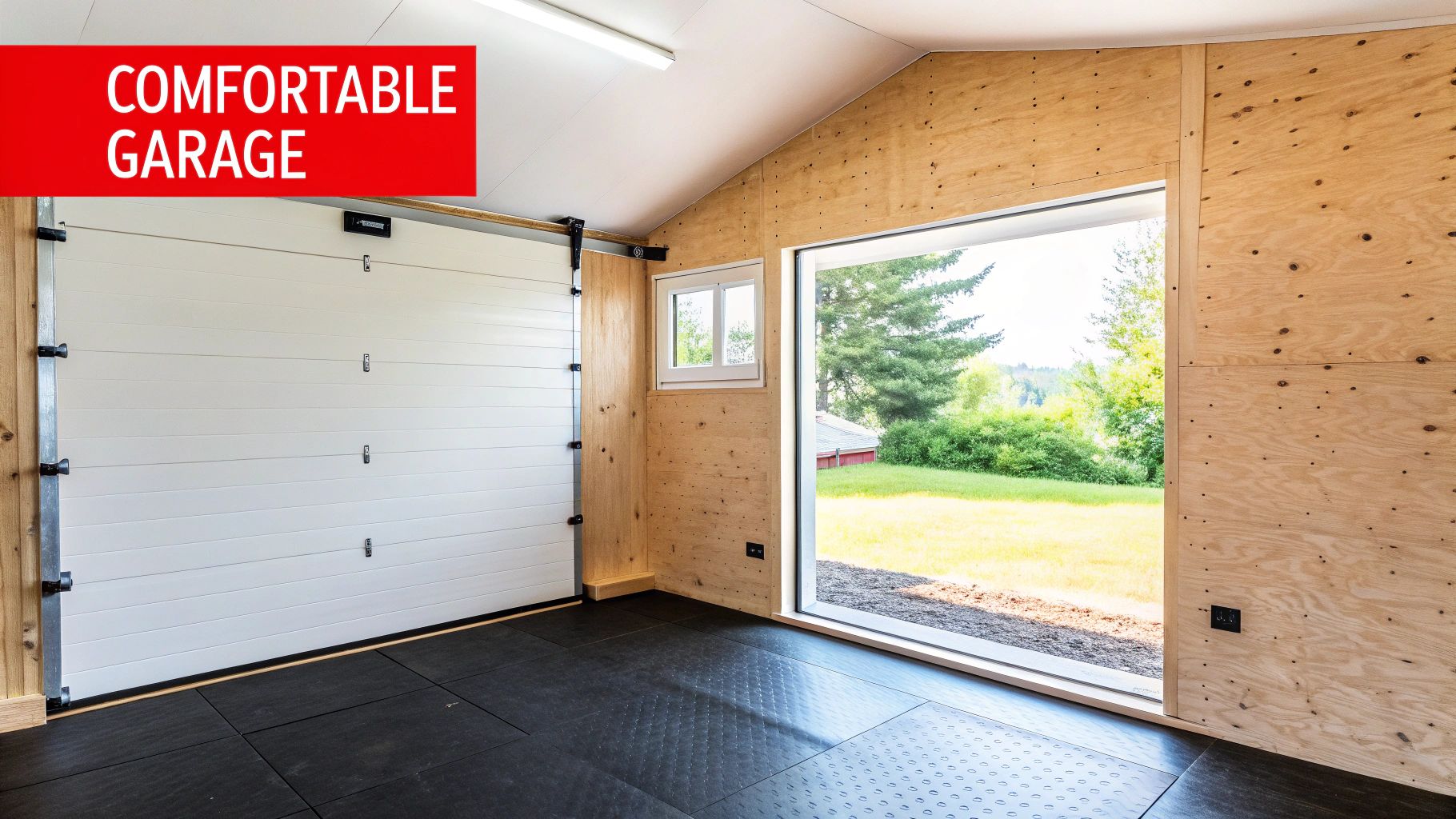
It begins with temperature stabilization. A well-insulated door acts as a thermal buffer, drastically reducing heat gain in the summer and preventing heat from escaping in the winter. What was once an unusable oven in July and an icebox in January becomes a climate-moderated area suitable for year-round activity.
Expanding Your Usable Square Footage
With stable temperatures, you unlock your garage's potential, adding valuable square footage without the expense of a home addition. This newfound comfort opens up numerous possibilities:
- Year-Round Workshop: Mechanics, artists, and hobbyists can work comfortably regardless of the season, while sensitive tools and materials are protected from damaging temperature extremes.
- Home Gym: Create a dedicated fitness area where you can exercise without battling triple-digit heat or shivering on a cold morning.
- Children’s Play Area: An insulated garage offers a safe, spacious zone for kids to play, protected from the elements.
- Better Storage: Protect temperature-sensitive valuables like classic cars, electronics, and keepsakes from the degradation caused by extreme heat and humidity.
The U.S. Department of Energy highlights that up to 30% of a home's heating and cooling energy can be lost through poorly insulated areas. By turning your garage into a thermal buffer, you not only make the garage more comfortable but also reduce the overall energy load on your entire home.
This upgrade is also a strategic advantage for businesses. An insulated door creates a more stable and productive work environment in warehouses, service bays, and workshops. Learn more about our specialized commercial door services that prioritize both durability and energy performance.
Creating a Quieter, More Peaceful Home
Beyond temperature control, the dense insulation in modern garage doors provides a powerful acoustic benefit. The same polyurethane or polystyrene foam that blocks heat is also excellent at absorbing sound waves.
This creates a quieter buffer between your home and the outside world. The noise from street traffic, neighborhood activities, and landscaping crews is significantly reduced. For any room sharing a wall with the garage, such as a bedroom or home office, this translates to a more peaceful, focused environment. This sound-dampening quality is an often-overlooked but highly valued benefit of improving garage door energy efficiency.
Selecting the Right Energy-Efficient Garage Door
Choosing the right energy-efficient garage door involves more than just picking the highest R-value. A truly efficient door is an integrated system where panels, insulation, and weather seals work in concert to create a robust thermal barrier.
For property owners in Texas and Oklahoma, this means selecting the right combination of materials and construction features to withstand our climate.
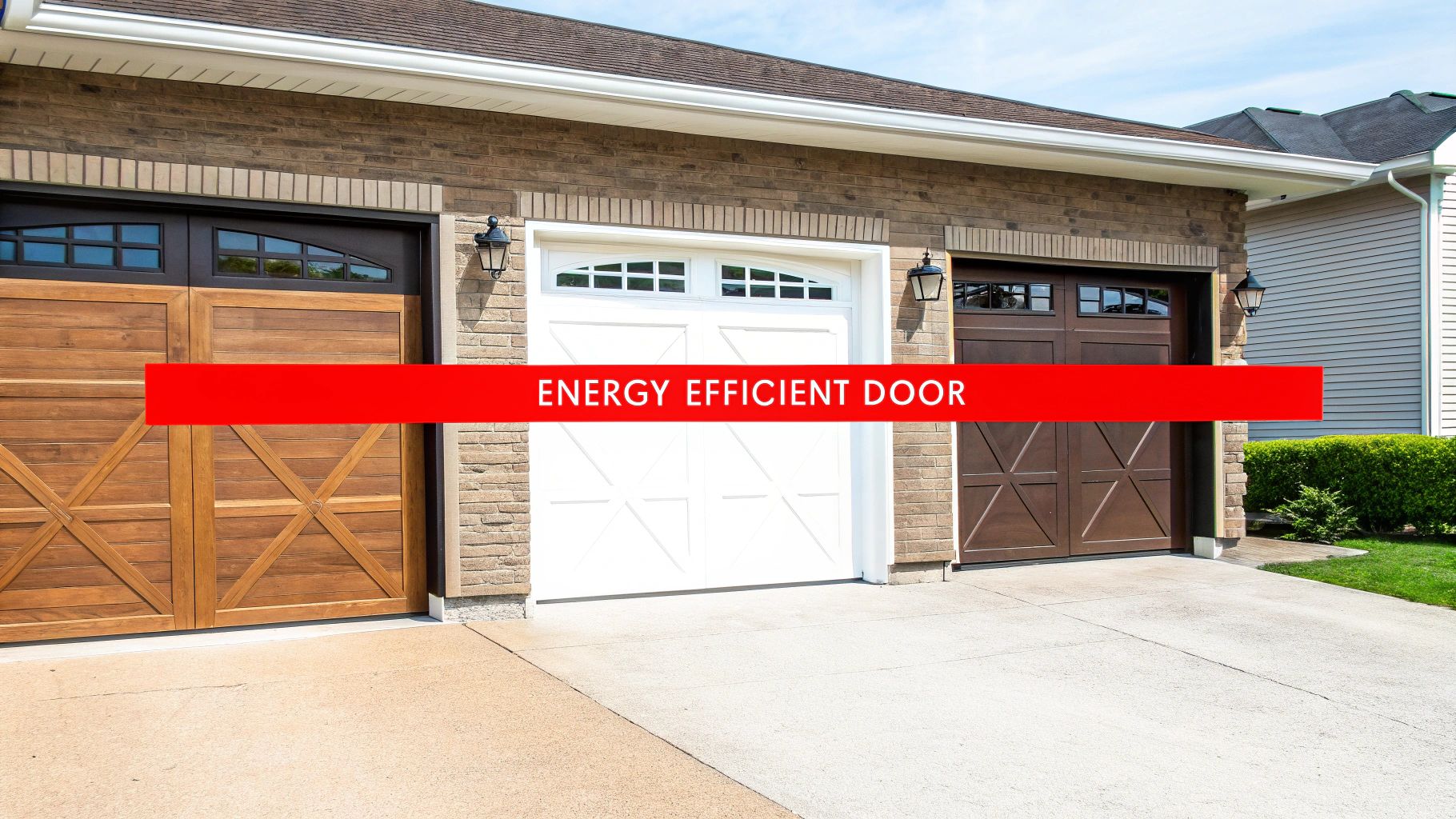
The door's material is a foundational choice, impacting durability, maintenance, and insulating capability.
Comparing Key Door Materials
Steel Garage Doors
Steel is the industry leader for its strength, affordability, and compatibility with high-R-value polyurethane insulation. For our region, a multi-layer insulated steel door provides excellent protection against hail, high winds, and daily wear and tear.
Aluminum Garage Doors
Lighter than steel and naturally resistant to rust and corrosion, aluminum is ideal for humid environments. Modern aluminum doors feature insulated frames and panels, offering a sleek, contemporary aesthetic without sacrificing thermal performance.
Wood Composite Doors
These doors offer the classic look of wood without the high maintenance. Made from wood fibers and resins, composite doors resist moisture, cracking, and splitting far better than solid wood and can be insulated for excellent energy efficiency.
Features Beyond Insulation
A high R-value is critical, but two other features are essential for creating an airtight seal.
-
Thermal Breaks: On standard metal doors, heat can travel directly through the frame. Doors with a thermal break incorporate a gap or non-conductive material between the inner and outer steel skins, which physically stops this heat transfer.
-
Robust Weather Seals: High-quality weatherstripping around the perimeter and a flexible, conforming seal along the bottom are crucial. These seals create an airtight barrier that blocks drafts, dust, and moisture, truly completing the insulated envelope.
The industry continues to advance, with top-tier garage doors now achieving U-factor ratings (a measure of heat flow) as low as 0.27, comparable to energy-efficient windows. This progress highlights the garage door's evolving role in modern building efficiency.
Special Considerations for Commercial Properties
For businesses in Texas and Oklahoma, an energy-efficient door must also meet rigorous demands for durability and high-cycle operation.
- High-Cycle Springs: Commercial doors may operate dozens of times per day. High-cycle springs are rated for 50,000, 75,000, or even 100,000 cycles, far exceeding the 10,000-cycle residential standard.
- Enhanced Durability: Warehouse and service bay doors require thicker gauge steel, reinforced struts, and impact-resistant panels to withstand industrial environments.
- Code Compliance: Commercial properties must adhere to strict building codes, including specifications for fire ratings (per NFPA 80), wind load requirements, and OSHA safety standards. A professional installer ensures your door meets all local and industry regulations.
Investing in an energy-efficient door is one of the few home renovation projects that add value to your property. The right door aligns with your operational needs, aesthetic preferences, and budget. Our team can guide you through every step, from selection to a professional garage door installation.
Keeping Your High-Performance Door in Peak Condition
You've invested in an energy-efficient garage door—a crucial first step. But like any high-performance equipment, it requires routine maintenance to deliver sustained energy savings. A quick annual tune-up is essential for protecting your home's thermal envelope.
A door that is unbalanced, has worn seals, or lacks proper lubrication can negate the benefits of its insulation. A simple preventative maintenance schedule protects your investment, maintains peak garage door energy efficiency, and helps you avoid costly future repairs.
Check Your Weather Seals
The weatherstripping around your door is your primary defense against the elements. Our region's intense sun and temperature swings can cause these vinyl or rubber seals to become cracked, brittle, or compressed over time.
A quick annual inspection is all it takes:
- Spot the Gaps: Close the garage door during the day and turn off the lights. Look for any daylight seeping in around the perimeter.
- Feel for Brittleness: The weatherstripping should be pliable. If it feels hard or cracks when pressed, it's time for replacement.
- Inspect the Bottom Seal: The astragal (bottom seal) should create a firm, continuous seal against the garage floor, conforming to any minor imperfections in the concrete.
A tiny quarter-inch gap along the bottom of a standard two-car garage door is equivalent to leaving a 6-inch window open 24/7. Replacing worn seals is a low-cost, high-impact maintenance task.
Test the Door's Balance and Lube the Moving Parts
An unbalanced door forces your opener to work harder, wasting electricity and potentially preventing the door from closing flush, creating air gaps.
To test the balance, disconnect the opener using the emergency release cord. Manually lift the door halfway and let go. A well-balanced door will stay in place. If it rises or falls, the springs require professional adjustment. An unbalanced door not only wastes energy but also causes premature wear on the opener's motor, a common cause of failure.
Proper lubrication is just as important. Use a silicone or lithium-based garage door lubricant every six months to spray all moving parts—rollers, hinges, and springs. This ensures smooth operation and allows the door to settle into a tight, secure seal.
Scan for Panel Damage
The integrity of your door's insulated panels is central to its performance. A dent, crack, or puncture can compress the insulation, creating a "thermal bridge"—a weak point where heat can easily pass through.
Periodically inspect both the interior and exterior of your door for any damage, especially at the seams between sections. While a minor scuff is cosmetic, a significant impact from a vehicle or equipment can compromise a panel's R-value.
If you find damage, or if the door operates loudly despite lubrication, it’s time to call a professional. Our team is equipped to handle any garage door repair, from spring adjustments to panel replacement, ensuring your door operates safely and efficiently.
Common Questions About Garage Door Efficiency
Upgrading a major component of your home or business is a significant decision. To help you proceed with confidence, here are clear, practical answers to the most common questions we receive from property owners in Texas and Oklahoma about garage door energy efficiency.
Is an Insulated Garage Door Worth It in a Hot Climate Like Texas?
Absolutely. In a hot climate, an insulated door is arguably more critical than in a cold one. While insulation is known for keeping heat in, its primary job is to resist heat transfer in either direction. In Texas and Oklahoma, the main battle is keeping intense summer heat out.
An uninsulated metal garage door can reach surface temperatures of 130°F or higher under direct sun, radiating that heat directly into your garage. An insulated door acts as a thermal break, stopping this process. The benefits are clear:
- A cooler garage that remains usable even in peak summer.
- Reduced heat transfer into adjacent living or working spaces.
- Less strain on your air conditioning system, leading to lower utility bills.
During a winter cold snap, that same insulation works in reverse, preventing expensive heated air from escaping. It's a year-round solution.
What is the Best R-Value for a Garage Door in This Region?
You don't need the maximum R-value available. For most homes and commercial buildings with attached garages in Texas and Oklahoma, the ideal performance-to-cost ratio is found in doors with an R-value between R-9 and R-13.
This range provides a highly effective thermal barrier against our climate's specific challenges without the premium cost of doors designed for extreme northern winters. It's a strategic choice that delivers tangible comfort and energy savings.
Can I Just Add an Insulation Kit to My Current Door?
While DIY insulation kits are available, we strongly advise against them for safety and performance reasons. A modern insulated garage door is an engineered, balanced system. Adding aftermarket insulation throws this system out of balance.
A factory-insulated door is designed as an integrated system where the panel weight, spring tension, and opener capacity are precisely matched. Adding weight from a DIY kit can cause catastrophic spring or opener failure, posing a significant safety risk recognized by industry standards like UL 325.
The added weight from a kit overloads the door's springs and opener motor. This leads to premature failure and can create a dangerous situation if a spring breaks under tension.
Will a New Insulated Door Really Lower My Electric Bill?
Yes. By stabilizing the temperature in your garage, an insulated door creates a thermal buffer for your entire building. Your HVAC system no longer has to compensate for the extreme temperatures penetrating what is effectively a giant uninsulated wall.
The U.S. Department of Energy states that homes can lose up to 30% of their heating and cooling energy through poorly sealed areas, with the garage door being a primary culprit. By properly insulating and sealing this opening, you reduce HVAC runtime. Less runtime directly translates to lower energy bills. The precise savings vary, but it is one of the most reliable home improvement projects for enhancing overall energy efficiency.
Whether you need a new garage door installation or an expert garage door repair, our team is ready to help optimize your property.
Ready to turn your garage into a more comfortable and efficient space? The team at Overhead Door Co. of Tex-Oma is here to guide you to the perfect door for your property. Contact us today for a free consultation and see how much you could save.
