
Your commercial garage door is so much more than just a way in and out. It’s a core piece of your daily operations, directly impacting your business's security, efficiency, and even your utility bills. Getting this choice right means you've invested in a strategic asset; getting it wrong can lead to constant headaches and unexpected costs, especially for businesses here in Texas and Oklahoma that contend with everything from blistering heat to intense storms.
The Strategic Role of Your Commercial Garage Door
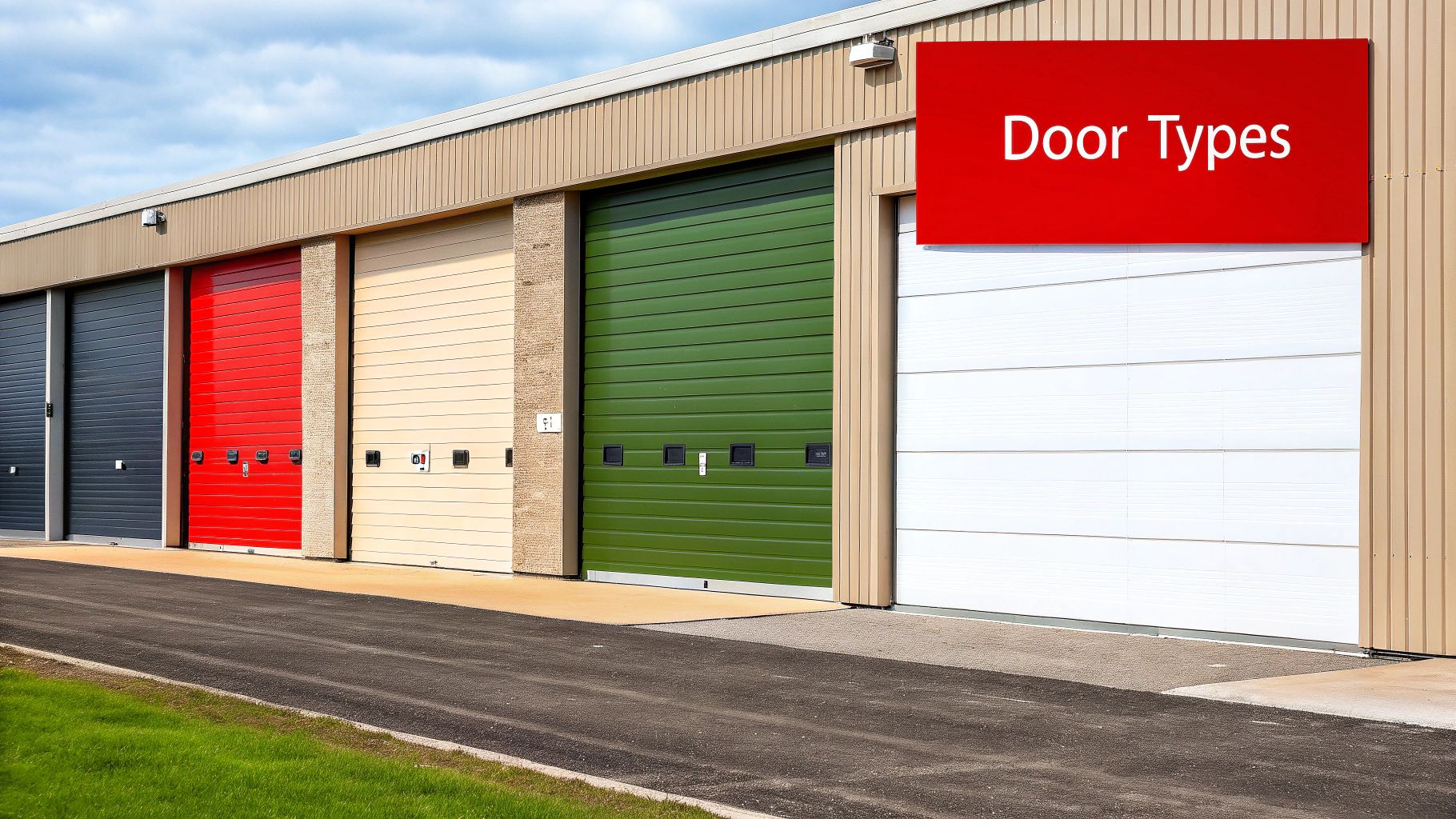
It’s easy to overlook, but think of your commercial garage door as the largest, most important moving part of your entire building. It’s the gatekeeper protecting your valuable inventory, a shield against the elements, and a key player in keeping your workflow moving smoothly.
Whether you run a busy logistics warehouse in Dallas or an agricultural operation in rural Oklahoma, that door's performance is directly tied to your productivity. A door that’s slow, inefficient, or constantly in need of commercial door repair can bring your entire operation to a grinding halt.
This guide isn't just a list of features. We’re going to dig into the practical side of things—how to choose a door that’s a true investment. One that pays you back with better efficiency, tighter security, and lower costs over its lifetime. My goal is to give you the insight to pick a door that actively helps your business, not one that holds it back.
More Than Just an Opening
Today's commercial garage doors are sophisticated systems built to handle specific, demanding jobs. Their impact is felt across your entire business, turning what seems like a simple building feature into a real competitive edge.
Let's break down its different roles:
- The Backbone of Your Operation: The right door keeps goods, vehicles, and people moving without a hitch. In a high-traffic loading dock, a high-cycle door can shave precious seconds off every single truck's turnaround time, which adds up to huge time savings over a year.
- Your First Line of Defense: This is a primary security barrier, often protecting thousands—if not millions—of dollars in assets from theft or vandalism. We know commercial properties are prime targets, making a heavy-duty, secure door an absolute must.
- A Regulator for Energy Costs: A properly insulated door with a high R-value can make a massive difference in your heating and cooling bills. That's a huge deal during a brutal Texas summer or a freezing Oklahoma winter, and it directly helps your bottom line.
A well-chosen commercial garage door is an investment in business continuity. A single day of downtime from a broken door can easily cost more than a full year of proactive professional maintenance. That really puts the value of reliability and durability into perspective.
At the end of the day, picking the right commercial garage door isn't about just plugging a hole in a wall. It's a strategic business decision. You have to weigh the materials, performance specs, and safety features to make sure you’re getting a powerful, reliable asset that will serve you well for years to come.
A Practical Guide to Commercial Door Types
Choosing the right commercial garage door is a lot like picking the right tool for the job. You wouldn't try to turn a screw with a hammer, and you shouldn't slap a door designed for a retail storefront onto a heavy-duty industrial warehouse.
For businesses all across Texas and Oklahoma—whether it’s an agricultural barn or a non-stop logistics hub—matching the door's function to your daily operations is absolutely critical. It’s the key to both efficiency and a long service life.
Let's walk through the main categories, starting with the common workhorses and moving into more specialized solutions. This will help you see exactly which style fits the unique rhythm of your business.
Sectional Doors: The Versatile All-Rounder
Think of a sectional door as the Ford F-150 of the commercial door world. It’s tough, adaptable, and a great fit for a huge range of jobs, which is why it's one of the most popular choices out there. These doors are made of several horizontal panels hinged together that roll up and back on a track system along the ceiling.
This design comes with some serious advantages:
- Insulation Options: Sectional doors can be packed with high-R-value insulation. This is a game-changer for controlling energy costs in climate-controlled spaces, especially when you’re battling an extreme Texas summer.
- Customization: You can get them with windows (also called "lites") for natural light, a variety of panel designs, and a whole spectrum of materials and colors to match your building's look.
- Space Efficiency: Since the door sits parallel to the ceiling when open, it doesn’t hog valuable real estate in front of or behind the opening. You get to use every square foot of your floor space.
Their do-it-all nature makes them perfect for auto repair shops, loading docks, and fire stations—places that need a solid blend of performance, insulation, and professional appearance.
Rolling Steel Doors: The Heavy-Duty Protector
When security and sheer toughness are your top priorities, rolling steel doors are the only way to go. Built from interlocking steel slats that coil up into a compact drum above the opening, these doors are engineered for high-traffic, high-impact environments. Picture them as the armored vehicle of the door world.
They’re the default choice for warehouses, manufacturing plants, and storage facilities for a reason. Their rugged construction can take a serious beating, and many are rated to withstand high wind loads—an essential feature in the storm-prone areas of Oklahoma and Texas.
The demand for these ultra-durable doors is on the rise as industrial and commercial activities expand, driving innovation in the market.
High-Speed Doors: The Efficiency Expert
In any operation where every second counts and climate control is non-negotiable, high-speed doors are a must. These specialized doors, often made from durable fabric or rubber, can open and close at incredible speeds of up to 100 inches per second. For comparison, a standard sectional door chugs along at about 8-12 inches per second.
A high-speed door is like a specialized forklift—it’s built for one specific, high-intensity task. It keeps conditioned air in, contaminants out, and traffic flowing without a hitch.
This makes them indispensable for:
- Food and beverage facilities where maintaining temperature is crucial for safety and quality.
- Pharmaceutical clean rooms that demand a sterile, controlled environment.
- Busy parking garages where vehicle flow needs to be seamless.
While they do require a larger upfront investment, the return you get from energy savings and massive productivity gains is often well worth it. For more on purpose-built structures, you can find good information on external garage units.
Matching Commercial Door Types to Business Needs
Feeling a little overwhelmed by the options? This quick-reference table breaks down the most common door types and shows you where they shine, making it easier to pinpoint the best fit for your business.
| Door Type | Primary Material | Best For | Key Feature |
|---|---|---|---|
| Sectional Door | Steel, Aluminum, Glass | Auto Shops, Fire Stations, Loading Docks, Retail | Highly customizable and excellent insulation |
| Rolling Steel | Steel, Stainless Steel | Warehouses, Manufacturing Plants, Self-Storage Facilities | Maximum durability and security |
| High-Speed Door | Fabric, Rubber, Vinyl | Food Processing, Cold Storage, Pharmaceutical, High-Traffic Garages | Extreme speed for climate and process control |
Ultimately, the goal is to find the door that not only meets your current needs but also supports your operational flow for years to come.
This infographic gives you a great visual summary of the key benefits and ideal uses for each type of commercial door.
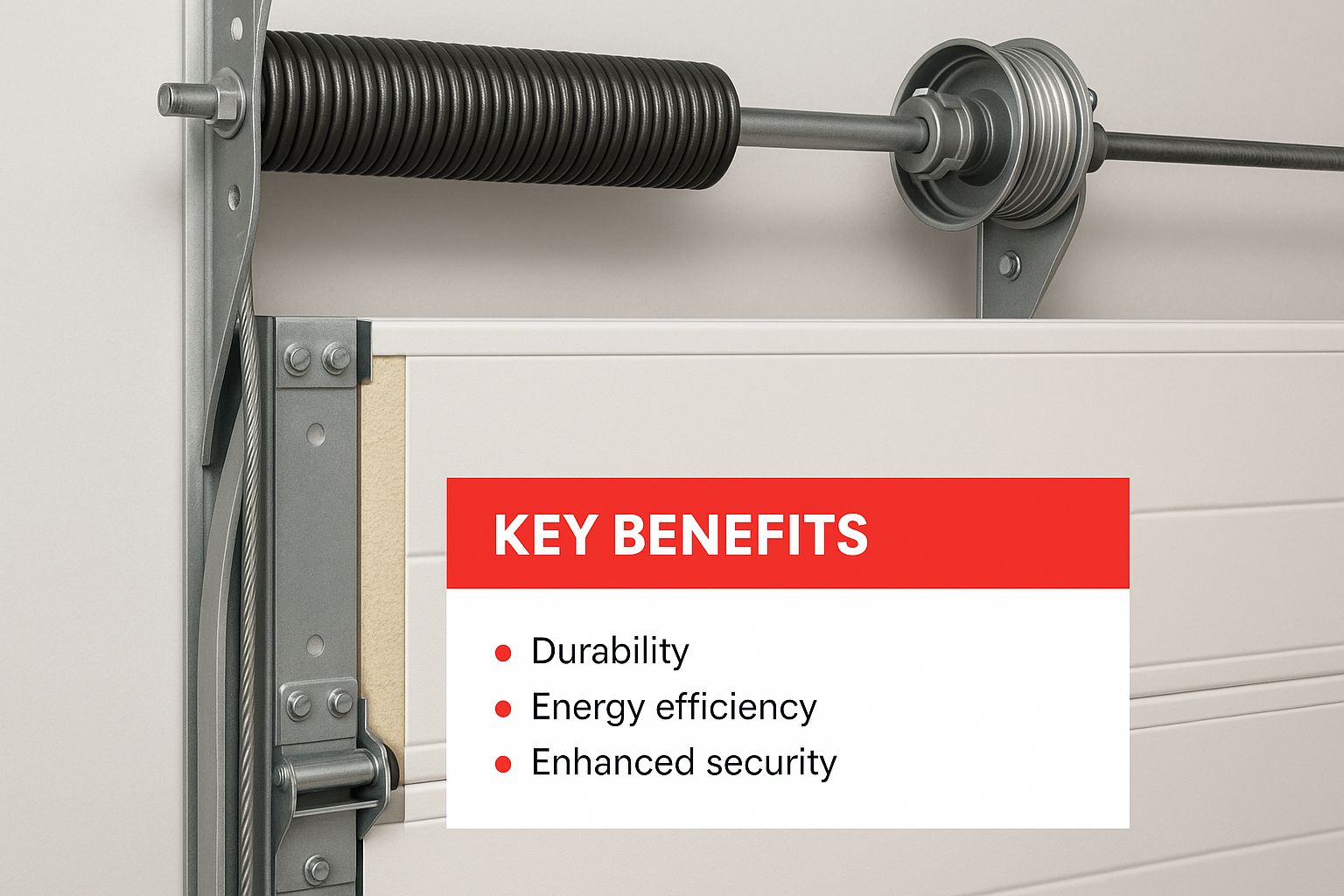
As you can see, each door is engineered to solve a specific business challenge. Making the right choice upfront is half the battle. Once you've picked your door, a professional commercial door installation is the final step to ensure it performs exactly as it was designed to.
Choosing the Right Materials and Construction for Your Door
The material of your commercial garage door is its core identity. It's what determines its strength, how secure it is, and how much maintenance it will demand over the years. Getting this choice right is like pouring a solid foundation—it ensures everything else performs as it should for a long, long time.
For any business owner, this decision directly impacts your bottom line and your ability to weather the daily grind. You wouldn't build the walls of a walk-in freezer with thin plywood, and the same principle applies here. It’s all about striking the right balance between the upfront cost and the long-term value you get from a door that just works.
Let's walk through the most common materials so you can see what makes the most sense for your operation.
Steel: The Industry's Heavy-Hitter
When it comes to commercial garage doors, steel is the undisputed champion. It’s the go-to for a reason, offering a fantastic blend of sheer toughness, security, and affordability. But here’s the key: not all steel doors are built the same. The most important thing to look at is the gauge.
The gauge tells you how thick the steel is, but it works in reverse—a lower gauge number means thicker, stronger steel. A tough, 24-gauge door will shrug off impacts that would easily dent a flimsier 28-gauge door. If your door is going to see a lot of action, investing in lower-gauge steel is one of the smartest decisions you can make.
- 20-24 Gauge: This is the premium stuff. It's built for high-traffic, high-impact environments like busy loading docks, warehouses, and manufacturing plants. Think maximum durability.
- 25-28 Gauge: This is a lighter-duty option that’s more budget-friendly. It’s a great fit for places with less traffic or a lower risk of dings and dents, like self-storage facilities or some retail stockrooms.
Aluminum: Lightweight, Modern, and Corrosion-Proof
Aluminum brings a completely different set of strengths to the table. First off, it’s much lighter than steel. This puts less wear and tear on the door's opener and springs, which can mean a longer service life for the whole system. But its real superpower is its natural resistance to rust and corrosion.
This makes aluminum the perfect choice for any business dealing with moisture—think car washes, food processing plants, or agricultural buildings in humid parts of Texas. Beyond its practical benefits, aluminum is also the go-to for modern, full-view glass doors. You see them everywhere from car dealerships and restaurants to fire stations, where they blend a clean, high-end look with rugged functionality.
A door’s material and build quality are direct predictors of its total cost of ownership. Investing a little more upfront for a lower-gauge steel door or a corrosion-resistant aluminum one can save you thousands in repairs and replacement costs down the road.
Insulation and R-Value: Your Defense Against the Elements
Here in Texas and Oklahoma, where we get scorching summers and surprise winter freezes, insulation isn't an optional upgrade; it's a core requirement for efficiency. A door's ability to resist heat transfer is measured by its R-value—the higher the R-value, the better the insulation.
For any business with a climate-controlled space, an insulated door is your first line of defense against high energy bills. It keeps the cool air in during the summer and the warm air in during the winter. Over time, the savings on your utility bills can be substantial. The garage door manufacturing industry is constantly innovating, with a heavy focus on energy efficiency. You can discover more industry growth insights about these garage door manufacturing trends.
For our region, we generally recommend an R-value of R-12 or higher to really make a difference. When you need to protect your inventory from extreme temperatures and keep your team comfortable, investing in good insulation pays for itself.
Understanding Essential Safety and Security Features
A commercial garage door isn't just a way in and out. It’s a massive, moving piece of equipment that stands between your business and the outside world, making it a cornerstone of both your daily safety and your property's security. Getting this part wrong isn't a small mistake—it can lead to costly downtime, serious liability issues, or devastating theft. For any business in Texas and Oklahoma, picking the right features is key to protecting your people and your assets.
Safety isn’t just a nice idea; it’s the law. Groups like OSHA (Occupational Safety and Health Administration) and UL (Underwriters Laboratories) have established clear, non-negotiable standards for commercial door systems. The big one to know is UL 325, which sets the safety benchmark for door operators, requiring specific features that prevent people or equipment from being trapped or crushed.
Following these rules isn't just about avoiding fines. It's about building a fundamentally safer place to work. After all, the cost of one serious accident will always be far greater than the investment in a compliant, high-quality door system.
Core Safety Mechanisms You Cannot Ignore
Think of these features as the essential guardians of your bay doors. They are designed to stop accidents before they can happen, protecting employees, customers, and valuable equipment. Any modern commercial garage door you consider should have these built-in.
- Photo-Eye Sensors: These are the unsung heroes of door safety. They shoot an invisible infrared beam across the opening. If a person, a pallet jack, or a forklift breaks that beam while the door is coming down, the system instantly stops and reverses. It's a simple concept, but misaligned or dirty photo-eyes are one of the top causes of door accidents.
- Reversing Mechanisms: This is the door's built-in sense of touch. If the door physically bumps into something on its way down, a well-tuned system will immediately reverse course. This acts as a critical failsafe, providing a second layer of protection if the photo-eyes somehow miss an obstruction.
- Emergency Manual Release: Power goes out. A motor fails. You still need to be able to open the door. The emergency release, usually a red cord or chain, disconnects the door from the opener, letting you operate it by hand. This ensures you can get people out and maybe even keep business moving during a disruption.
Bolstering Security to Protect Your Assets
While safety features are all about protecting people, security features are what protect your stuff. Your garage door can be a tempting target for thieves, so treating its security as an afterthought is a risky gamble.
A simple lock and key just doesn't cut it anymore.
In 2022, burglaries at non-residential properties led to over $2.4 billion in losses across the U.S. A genuinely secure commercial door is your first and best line of defense against becoming another statistic.
You can significantly beef up your defenses with a few key upgrades. High-cycle springs, for instance, are engineered for heavy use, so they're far less likely to fail and leave your door vulnerable. You can also add tamper-resistant locks and heavy-duty slide locks that provide a physical barrier much tougher to break than a standard lock. To see what’s possible, it’s worth exploring specialized commercial door accessories that are made specifically for hardening your entry points.
For those looking to create a truly secure environment, integrating your door with a complete system for access control for business security is the next logical step. This ties your door's security into a larger strategy, giving you total command over who comes and goes. Ultimately, investing in the right safety and security features turns your commercial door from a potential weak spot into a reliable, protective asset.
Keeping Your Operation Running Smoothly
Picking the right commercial garage door is a great start, but it's really just the beginning. To see a real return on that investment, you have to think about the long game: performance over time and the total cost of ownership. This means looking past the initial price tag to understand how the right motor and a solid maintenance plan can keep your business running without a hitch.
A door that’s down isn't just a minor problem; it's a bottleneck that can bring your entire operation to a standstill. For any business in Texas or Oklahoma, every minute of downtime costs money, making a reliable door system an essential part of your strategy.
Matching the Motor to the Mission
The engine driving your door's performance is its operator, and the most critical factor to consider is its duty cycle rating. This isn't just some technical spec; it tells you exactly how many times a day the motor can open and close without burning itself out. Think of it this way: you wouldn't use a family sedan to haul a load of bricks.
Putting a light-duty operator on a door in a busy warehouse is a surefire way to cause a breakdown. The motor simply isn't built for that level of constant use and will fail, leading to expensive emergency calls and a whole lot of operational chaos. Matching the duty cycle to your daily traffic is the single best way to ensure your door is a reliable workhorse, not a constant source of frustration.
Why Proactive Maintenance Saves You Money
Preventative maintenance isn't just another expense—it's one of the smartest financial decisions you can make for your facility. A single day of downtime from a broken door can easily cost you more than a full year of routine service. That’s before you even factor in lost productivity, delayed shipments, or the premium you’ll pay for an emergency repair.
The global market for garage door services is expected to hit USD 7.16 billion by 2032, and a huge chunk of that is driven by repair and maintenance. This trend shows a clear, industry-wide recognition that consistent upkeep is the key to a door's longevity and performance. You can dig deeper into these numbers in the full industry report on garage door services.
A simple, consistent maintenance plan helps you spot small problems before they turn into major, business-stopping failures. For facility managers and business owners, these regular checks are your first line of defense.
A Practical Maintenance Checklist
Here’s a simple checklist you can use to stay ahead of potential issues. Running through these steps every quarter can add years to the life of your commercial door.
- Look Things Over: Take a walk around the door. Are there any frayed cables? Worn-out rollers? Obvious signs of stress on the springs or hinges? Catching these things early makes all the difference.
- Keep it Lubricated: All those moving metal parts need lubrication to cut down on friction. A high-quality lubricant on the hinges, rollers, and springs—based on the manufacturer's guidelines—will keep everything moving smoothly.
- Check the Safety Sensors: Test your photo-eye sensors once a month. Just place an object in the beam's path while the door is closing. It should immediately reverse. If it doesn’t, the sensors could be dirty or misaligned, which is a major safety risk.
- Test the Balance: Disconnect the operator and try lifting the door by hand. It should stay put about halfway up. If it slams down or flies up, the springs need professional adjustment right away.
While these DIY checks are incredibly important, they aren’t a substitute for a professional tune-up. If you spot a serious issue or just aren't comfortable making an adjustment, the safest bet is to call in an expert. Our team is equipped for comprehensive commercial door repair, making sure your system is safe, up to code, and running just as it should.
How to Make a Smart Purchase Decision
You've done the homework on door types, materials, and safety features. Now for the most critical step: choosing the right partner to bring it all together.
A top-of-the-line commercial garage door is only as good as its installation. Think about it—even the best product will fail if it's not set up correctly, leading to constant headaches and unexpected downtime. The goal isn't just to buy a door; it's to invest in a reliable, long-term solution.
Your final decision should come down to finding a company that sees this as a partnership, not just a sale. This means doing your due diligence to make sure they have the experience, credentials, and local know-how to get the job done right.
Vetting Your Installation Partner
Before signing on the dotted line, it's time to ask some tough questions. A truly professional installer will have no problem providing clear, confident answers. Treat this like an interview for a key member of your operations team—because that's exactly what they are.
Use this checklist as your guide when talking to installers in Texas and Oklahoma:
- Licensing and Insurance: Are they fully licensed and insured? Ask for proof of general liability and workers' compensation. This is non-negotiable, as it protects you from any liability if an accident happens on your property.
- Local Code Compliance: How well do they know the specific building codes for your city? A team with deep local roots will understand the wind load requirements and navigate the permitting process without a hitch.
- Warranty Details: What kind of warranty do they offer? You need to understand the manufacturer's warranty on the door itself and the installer's guarantee on their labor. Get the specifics in writing.
- Service Response Times: What happens when something goes wrong? Ask about their guaranteed response time for emergency service calls. When a door is stuck, every minute of downtime costs you money.
Choosing an installer isn’t just about the day of the installation. It’s about starting a relationship with a team you can count on for maintenance, repairs, and support for years to come.
Making the right choice means looking beyond the price tag to see the full picture: product quality, installation expertise, and a commitment to ongoing service. For a smooth experience from start to finish, it helps to understand what a professional commercial door installation actually involves.
By asking these critical questions, you’re not just buying a door—you’re securing a valuable asset for your business.
Answering Your Questions About Commercial Doors
When you're running a business, you need straightforward answers, not guesswork. I get a lot of questions from business owners across Texas and Oklahoma about commercial garage doors, from the initial price tag to how to keep them running smoothly for years. Let's tackle some of the most common ones head-on.
How Much Does a Commercial Garage Door Cost?
This is usually the first question, and the honest answer is: it depends. A simple, no-frills sectional steel door might run you a few thousand dollars. But if you need a specialized high-speed door for a cold storage facility, you could be looking at an investment upwards of $15,000.
Think of it like buying a vehicle for your business—the final price comes down to what you need it to do.
- Size: Bigger doors mean more material and a beefier operator.
- Material: Heavy-duty steel costs more than a lighter gauge, and full-view glass and aluminum doors are a premium choice for both function and aesthetics.
- Insulation: A higher R-value adds to the upfront cost, but it pays you back in energy savings month after month.
- Features: Things like high-cycle springs, advanced security locks, and smart operators will also affect the bottom line.
Ultimately, you're not just buying a door; you're investing in your business's efficiency, security, and workflow. The right door pays for itself over time.
What Is the Typical Lifespan of a Commercial Door?
With proper care, a quality commercial door can easily last 20 years or more. The real wildcard in its lifespan isn't the door itself, but the springs. Standard commercial springs are typically rated for around 20,000 to 25,000 cycles. A "cycle" is just one full opening and closing.
For a small shop that opens its bay door 10 times a day, those springs might last over six years. But for a bustling distribution center cycling the door 100 times a day, you'd be lucky to get a year out of them. That's why for any high-traffic operation, I always recommend upgrading to high-cycle springs, which can handle 100,000 cycles or more.
The single best thing you can do to get the most out of your door is to stick to a professional maintenance plan. It’s all about catching the small stuff—worn rollers, loose cables—before they turn into a major shutdown that costs you time and money.
How Often Should I Schedule Professional Maintenance?
For the average business, getting a professional tune-up and safety check at least once a year is a solid rule of thumb. This gives a trained technician the chance to lubricate everything, check the spring tension, and test critical safety features to ensure the door is compliant and, more importantly, safe.
Now, if you’re running a car wash, a logistics hub, or an emergency vehicle bay, you need to be more proactive. For high-use doors like these, scheduling a check-up every six months is smart business. It keeps your door from becoming an unexpected liability and prevents costly downtime. And if you ever hear grinding, see the door moving slowly, or notice it looks crooked, don't wait—call for a commercial door repair right away.
Can I Replace a Single Damaged Panel?
Absolutely. In most situations, you don't need to replace the entire door just because one section gets damaged. If a forklift nicks a bottom panel or a truck backs into the door, we can almost always swap out just the damaged section. That’s one of the best things about a sectional door design.
The important thing is to get it fixed quickly. A bent or broken panel can throw the whole system out of alignment, putting a ton of stress on the tracks, rollers, and even the opener. We can source a matching panel and get your door back to working order, protecting your original investment and keeping things running safely.
Ready to find a commercial door that truly works for your business—improving your security, efficiency, and day-to-day operations? The team at Overhead Door Co. of Tex-Oma has been helping businesses in Texas and Oklahoma do just that for years.
Contact us today to get a personalized quote and expert guidance.
